Scrolling through real estate listings feels like staring at the same beige wall fifty times in a row. Every kitchen looks identical and every living room claims to be spacious while looking like a shoebox. Buyers are exhausted and their attention spans are basically nonexistent at this point.
The traditional playbook of snapping a few wide angle photos and calling it a day is officially dead. Gen Z and millennial buyers grew up on immersive gaming worlds and cinematic trailers. They expect properties to sell them a lifestyle before they ever step through the front door.
This is exactly where the market started bleeding money and losing leads. Static images cannot convey scale, flow, or the emotional weight of walking into a sunset lit penthouse. Furthermore, developers sitting on pre construction projects have literally nothing physical to show buyers except dusty lots and architectural sketches.
The competitive landscape has become absolutely brutal. Every major metro from Atlanta to Seattle is flooded with new developments fighting for the same pool of qualified buyers. Standing out requires more than granite countertops and stainless steel appliances. It demands storytelling that makes someone stop scrolling and actually feel something.
What is real estate 3D animation
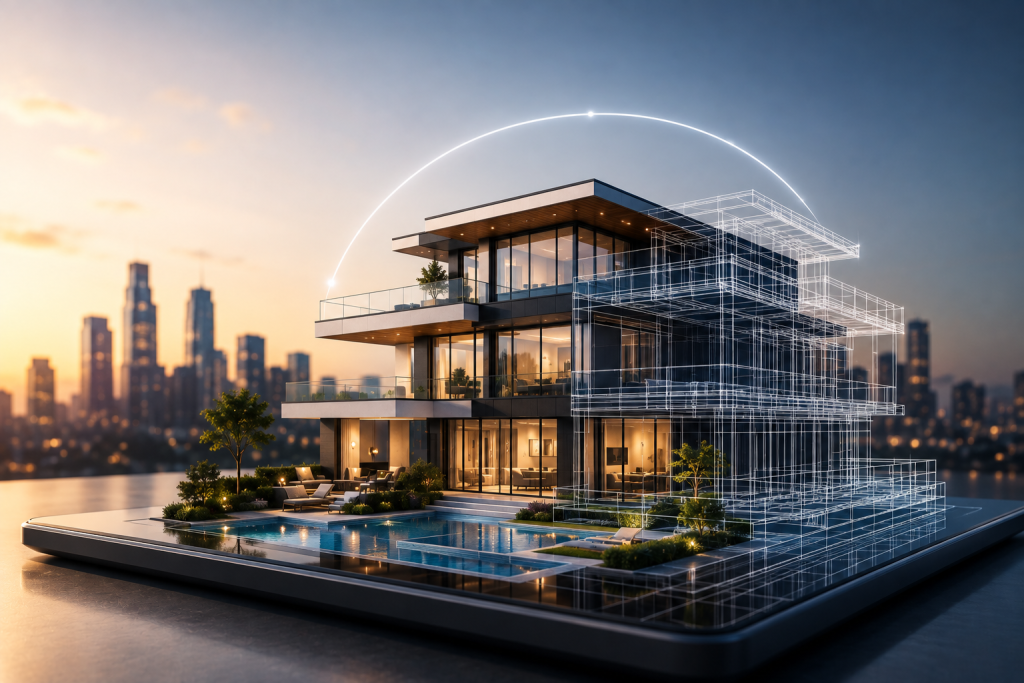
Real estate 3D animation is the process of building hyper realistic digital models of properties and rendering them into cinematic walkthroughs. Think of it as creating a movie trailer for a house or an entire development before a single brick gets laid. These animations showcase interiors, exteriors, landscaping, and even neighborhood context with photorealistic precision.
Unlike static renders, these are dynamic sequences with camera movement, lighting shifts, and atmospheric effects. A viewer glides through the foyer, drifts past the kitchen island, and steps onto a balcony overlooking the city skyline. Furthermore, these experiences run on websites, social feeds, and presentation screens without requiring bulky virtual reality headsets.
The technology has evolved past clunky CAD flythroughs from the early two thousands. Modern pipelines use real time engines and ray tracing to achieve results indistinguishable from high end photography. Consequently, 3D animation services USA have become the standard expectation for luxury and commercial developments across major American markets.
Does 3D animation sell properties faster
Properties marketed with animated content move significantly quicker than those relying solely on traditional media. Buyers form emotional attachments within seconds of watching a cinematic tour and emotional attachment drives offers. Moreover, listings featuring animation receive substantially higher engagement rates on platforms like Zillow and Realtor dot com.
Pre construction sales used to drag on for months because buyers struggled to visualize finished spaces from floor plans. Animated walkthroughs eliminate that friction by letting prospects experience the finished product immediately. Furthermore, international investors can evaluate American properties remotely without flying across continents for site visits.
Speed matters in competitive markets like Miami, Austin, and Manhattan where inventory shifts rapidly. Agents using animation report shorter days on market and fewer wasted showings from unqualified buyers. Ultimately, the question is not whether animation sells faster but how much money you are leaving on the table without it.
Why use 3D animation over photos
Photography captures what already exists and nothing more. It cannot show a building that has not been constructed or a renovation that exists only in blueprints. Furthermore, even the best real estate photographer struggles with awkward angles, bad weather, and cluttered spaces that ruin otherwise beautiful properties.
Animation removes every single one of those limitations. You control the lighting, the staging, the time of day, and the camera path. A gloomy Tuesday afternoon shoot becomes a golden hour masterpiece without rescheduling or praying for clear skies.
The comparison becomes even more stark when marketing unbuilt developments. Photos of construction sites and dirt lots kill buyer enthusiasm instantly. 3D vs 2D animation is not even the main debate anymore because flat floor plans and static renders have already been lost. Three dimensional storytelling is the only format that competes with the imagination of a serious buyer.
How much does real estate 3D animation cost
Pricing varies wildly depending on project scope, detail level, and delivery timeline. A single family home animation might start around two thousand dollars while a full master planned community could climb past fifty thousand. Furthermore, rush deliveries and custom music licensing add premiums that scale with complexity.
Most reputable studios structure quotes based on square footage, scene count, and revision rounds. A thirty second social media teaser costs significantly less than a three minute cinematic walkthrough with voiceover. Additionally, interactive elements like clickable hotspots or virtual staging overlays require separate development budgets.
The 3D animation cost conversation should focus on return rather than expense. A ten thousand dollar animation that accelerates pre sales by three months pays for itself immediately. Moreover, the asset remains usable across multiple campaigns, trade shows, and investor presentations for years.
What are benefits of 3D animation for developers
Developers gain a massive strategic advantage by showing finished visions before breaking ground. Pre-sales funded by buyer deposits reduce construction loan burdens and improve cash flow projections. Furthermore, animated materials help secure zoning approvals by showing community stakeholders exactly how a project integrates with its surroundings.
Marketing teams reuse animation assets across billboards, websites, social campaigns, and sales center displays. This consistency builds brand recognition while eliminating the need for separate photoshoots at every construction milestone. Additionally, changes to finishes or layouts can be updated digitally without reshooting physical spaces.
Risk mitigation represents another underrated benefit. Animated previews reveal spatial issues and design conflicts before they become expensive construction mistakes. Consequently, professional 3D animation companies in USA now serve as strategic partners rather than mere vendors.
Which USA companies use real estate 3D animation
Major developers across every significant American market have adopted animation as standard practice. Related Companies in New York, Lennar in Florida, and Trammell Crow in Texas all leverage cinematic visualization for flagship projects. Furthermore, boutique architecture firms in Los Angeles and Chicago use animation to win competitions and secure municipal approvals.
The trend has filtered down to mid market multifamily developers and regional home builders. Even smaller firms in secondary markets like Nashville and Phoenix now commission animations to compete with national brands. Moreover, proptech startups use animated assets to power virtual leasing platforms and digital twin experiences.
Split Arts has delivered visualization work for developers ranging from luxury Manhattan condos to mixed use projects in emerging Sun Belt cities. Their portfolio spans residential towers, hospitality concepts, and master planned communities. Furthermore, their pipeline integrates seamlessly with 3d animation walkthrough services tailored specifically for American zoning boards and investor presentations.
Can 3D animation replace video walkthroughs
Animation complements live video but increasingly replaces it in specific contexts. Pre construction marketing has no physical space to film so animation becomes the only viable option. Furthermore, properties under renovation or occupied by tenants often present filming obstacles that animation sidesteps entirely.
Live video walkthroughs excel at showing authentic neighborhood sounds and natural lighting conditions. However, they cannot control weather, remove clutter, or visualize future renovations. 3D animation agency USA teams increasingly blend both approaches by compositing animated elements into live footage.
The smartest marketers use animation for hero content and reserve live video for supplementary social proof. This hybrid strategy captures imagination while maintaining authenticity. Ultimately, the goal is not replacement but optimization of every available visual tool.
The Process Behind Real Estate Animation
Every project begins with architectural drawings, material specifications, and reference photography. The production team builds accurate three dimensional models of every structural element and interior finish. Furthermore, environmental context including neighboring buildings and landscaping gets modeled to establish realistic sightlines.
Texturing and lighting artists apply surface materials and configure virtual sun positions to match target seasons and times of day. Camera paths get blocked out like film scenes with deliberate pacing and focal points. Additionally, post production adds motion graphics, music, and color grading that aligns with the developer’s brand identity.
Quality assurance happens through multiple review cycles where clients provide feedback on materials, camera moves, and overall mood. Revisions typically cover furniture swaps, lighting adjustments, and landscaping tweaks. Once approved, the final render farm processes high resolution frames that get compiled into the finished cinematic piece.
Delivery formats include high resolution MP4 files, compressed web versions, and vertical crops for Instagram Reels and TikTok. Most studios offer two to three revision rounds to refine materials and lighting. Consequently, timelines typically range from four to eight weeks depending on project complexity.
Pricing and Value Breakdown
Entry level residential animations start around fifteen hundred to three thousand dollars for basic exterior flyovers. Mid tier interior walkthroughs with furniture staging run between five thousand and twelve thousand. Furthermore, large scale master plans with multiple buildings and drone matched camera paths can exceed twenty five thousand.
Value increases dramatically when you factor in asset reuse. That single animation becomes content for Facebook ads, email campaigns, sales deck backgrounds, and trade show loops. Moreover, updated versions cost fractions of the original since the base model already exists.
Smart developers budget for animation during pre construction phases rather than treating it as a last minute marketing add on. Early integration ensures visual assets align with branding and sales timelines. Ultimately, the investment generates measurable returns through faster absorption rates and higher price per square foot.
Frequently Asked Questions
What file formats do animation studios deliver?
Most deliver high resolution MP4 files along with compressed web optimized versions. Some offer ProRes or uncompressed frames for broadcast use. Furthermore, interactive web players and social media crops are usually available as add ons.
How long does production take?
Typical timelines range from four to eight weeks depending on scene complexity and revision rounds. Rush deliveries are possible but cost significantly more. Moreover, starting animation production before construction begins ensures assets are ready for launch.
Can animations show seasonal changes?
Absolutely. Studios can render the same property in summer greenery, autumn foliage, or winter snow. This versatility helps buyers visualize year round livability. Additionally, seasonal variations make excellent social media content calendars.
Do I need architectural drawings to start?
Yes, CAD files, Revit models, or detailed PDF plans are necessary for accurate modeling. Some studios offer conceptual visualization from sketches but accuracy improves dramatically with technical drawings. Furthermore, material specifications and finish schedules help achieve photorealistic results.
Is animation better than virtual reality tours?
Animation reaches broader audiences because it requires no special hardware. VR tours offer deeper immersion but limit viewership to users with headsets. Moreover, animated videos are infinitely easier to share via email and social platforms.
Can I update the animation after construction finishes?
Yes, and this is where the real value compounds. The original three dimensional model can be re rendered with actual photography mapped onto surfaces. This means your marketing asset evolves alongside your project rather than becoming obsolete.
Conclusion
Real estate marketing in the USA has crossed a threshold where static media simply cannot compete. Buyers expect cinematic experiences that transport them into spaces before those spaces physically exist. The developers winning right now are the ones investing in visualization that matches the ambition of their projects.
Split Arts builds 3D animation services like 3D product rendering that help American developers pre-sell faster, secure approvals easier, and market smarter. Their team understands that every frame needs to sell a lifestyle, not just square footage. Furthermore, they deliver assets that perform across every channel from Instagram Reels to investor boardrooms.
If your listings are sitting stagnant or your pre construction sales are lagging, the problem is not your property. It is your presentation. Reach out to Split Arts and let them show you what your development actually looks like when it gets the cinematic treatment it deserves.