When was the last time you bought something online that cost more than fifty bucks without watching at least one video of it first?
Exactly!
Now flip that around, because you’re the one who is selling this time. A shopper lands on your product on a random day. Your serum bottle, your sneaker, your smart kettle, sitting there in six nicely lit photos. Front angle. Side angle. Label close-up. She scrolls. She zooms. She hovers for a second.
Then she opens a new tab.
Not because your product wasn’t good. Because she still couldn’t feel it. How big is it, really? Does the finish look premium, or just photographed well? That tiny gap between “I like it” and “I’m sure” is where DTC sales quietly go to die, thousands of times a day.
That gap is exactly what 3D product animation closes. And across the USA, the fastest-growing direct-to-consumer brands have stopped treating it as a nice-to-have. Now, let’s further ado, let’s get into it.
Why Customer Experience Is the Biggest Growth Driver for DTC Brands
Selling direct sounds simple: no middleman, better margins, your own customer relationships. But there’s a catch nobody puts on the pitch deck. When you cut out the retailer, you also cut out the retail experience, the shelf, the helpful associate, the moment a shopper picks your product up and turns it over in their hands.
Your product page has to do all of that now, salesperson, packaging, and fitting room squeezed into one screen. Brands that get this are growing. Brands still leaning on a white-background photo gallery are wondering where their conversions went.
Why today’s customers expect more than product photos
Blame TikTok. Blame the unboxing videos with forty million views. Today’s shoppers grew up watching products move, spinning, opening, pouring, clicking into place. A static photo grid feels like a catalog from 2012 next to that.
This isn’t a vibe, it’s documented behavior. Wyzowl’s video marketing research found that 91% of consumers have watched an explainer video to learn about a product or service, and 82% say watching a video has convinced them to buy. Your customers are telling you exactly how they want to shop. Most stores just aren’t listening yet.
How customer experience influences buying decisions
Here’s the thing about online buying: people decide with emotion and justify with logic. Does this feel premium? Can I picture it in my life? A flat photo can’t answer that. An experience can. When a shopper watches your coffee maker’s brew head descend and steam rise, she’s not analyzing specs, she’s imagining Saturday morning. That shift is the moment a browser becomes a buyer.
The cost of poor product presentation
Poor presentation doesn’t just fail to sell, it actively costs you money. Not once, but twice.
First, the sale that never happens. Seven out of ten shoppers who add to a cart leave without paying, and a big slice of that is pure product doubt.
Then the sale that boomerangs. The National Retail Federation reports US shoppers returned an estimated $890 billion in merchandise in 2024. Processing one return costs $25 to $30, according to Narvar. And the most common reason?
“Item not as expected.”
Read that again. Not broken. Not the wrong size.
Just, a presentation problem, and presentation problems have presentation solutions.
How 3D Product Animation Creates Memorable Shopping Experiences
Bringing products to life before purchase
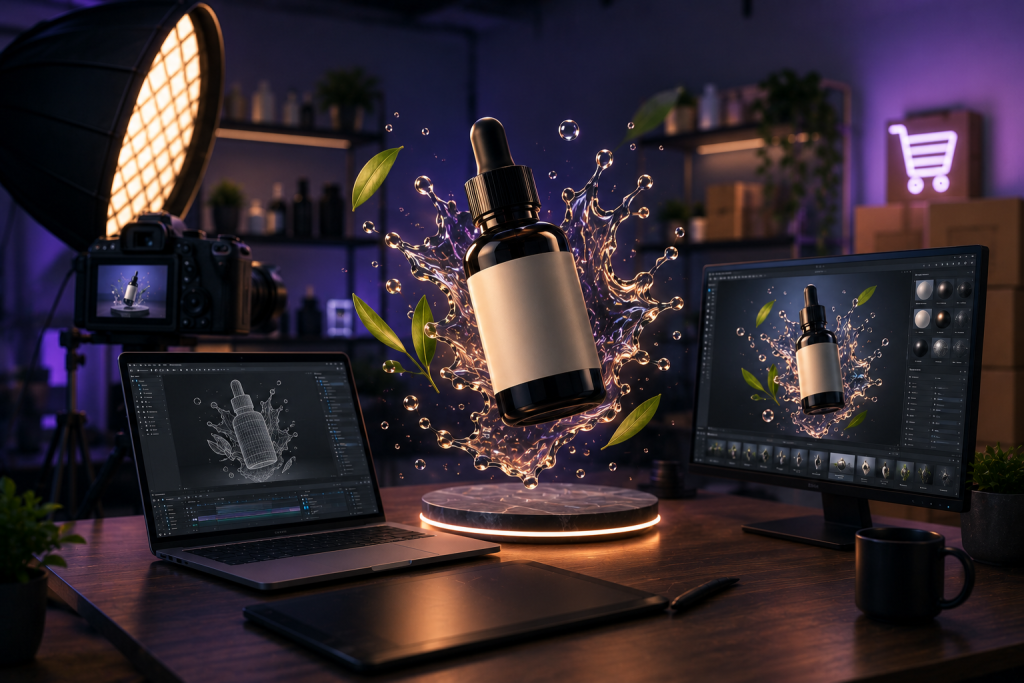
A 3D animation lets a shopper watch your watch’s clasp click shut. Your backpack’s laptop sleeve slides open. Your serum’s texture as it pumps out. Exploded-view animations go further, pulling the product apart layer by layer to show the engineering inside, the closest thing to handing it over through the screen.
Creating interactive and engaging product journeys
Static galleries are a lecture. Interactive 3D is a conversation. When shoppers can spin a product 360 degrees, swap colorways, or trigger animations themselves, they start feeling ownership before paying a cent. Psychologists call it the endowment effect. Marketers call it Tuesday.
Building emotional connections with customers
Movement creates mood. A candle is wax and string in a photo. In animation, it’s a flame flickering at dusk in a living room getting warmer. You’re not selling a candle anymore — you’re selling the feeling of being home.
Some brands go further with mascots that give a product real personality. Studios offering affordable character animation services can build your character once and reuse it across launches and campaigns, a cast member that never asks for a raise.
Why DTC Brands Are Moving Beyond Traditional Product Photography
Let’s be fair: photography isn’t dead. A great hero shot still matters. But for a growing DTC catalog, photography alone has quietly become the expensive, inflexible option.
The limitations of static product images
One angle, one moment, one context, and the shopper’s imagination fills the gaps. Imagination is a terrible sales rep.
- Every colorway, every variant, every seasonal refresh means booking another shoot.
- You can’t photograph a product that hasn’t been manufactured yet, which kills pre-launch marketing.
- Mechanisms, textures in motion, and true scale are nearly impossible to communicate in stills.
- Reshoots for marketplace, social, and email formats multiply costs fast.
3D animation vs traditional product photography
Put the two side by side and the gap gets obvious fast:
| Factor | 3D Product Animation | Traditional Photography |
| Product clarity | Every angle, inside and out, in motion | A handful of fixed angles |
| Launch timing | Weeks before manufacturing finishes | Only after samples exist |
| New colorways & variants | Swap materials digitally in hours | Book a new shoot each time |
| Ad versatility | One master file → dozens of cutdowns, loops, GIFs | One shoot → one set of stills |
| Cost as catalog grows | Falls as assets get reused | Rises with every reshoot |
| Return-rate impact | Reduces “not as expected” surprises | Leaves room for imagination (and returns) |
Which approach delivers better engagement?
Shopify has published the most-cited number in this space: merchants adding 3D content see a 94% conversion lift on average among shoppers who interact with it. In the Rebecca Minkoff case, shoppers were 65% more likely to order after viewing a product in AR and 27% more likely after a 3D view.
Numbers like that are why established 3D Product Animation companies now work with DTC catalogs the way ad agencies used to work with TV budgets. The gap between motion and stills isn’t a rounding error, it’s the difference between a scroll-past and a stop.
How 3D Product Animation Increases Trust Before the First Purchase
First purchases are pure risk. No history with your brand, no guarantee the box matches the photos. Trust has to be built on-screen, and nothing builds it like showing everything.
Showing every product detail with confidence
There’s a psychological signal in showing the underside. The seams. The hinge from fourteen angles.
It says: we have nothing to hide, and shoppers read that instantly, even if they couldn’t articulate it.
Reducing uncertainty and product returns
Remember the $890 billion returns problem?
Most of it is an expectation mismatch, what arrived wasn’t what the shopper pictured. 3D animation aligns the two before money changes hands. Industry data on 3D and AR visualization points to return-rate drops of up to 40% where fit, scale, and assembly matter. At $25 to $30 per return, that’s not a design upgrade. That’s margin defense.
Helping customers make faster buying decisions
Hesitation is expensive. Every unanswered question opens a new tab, a new comparison search, a new chance for a competitor’s retargeting ad to steal the sale you already earned. When a shopper can see exactly what she’s getting, every angle, in motion, at true scale, the decision compresses from “let me think about it” to “where do I pay.”
How Successful USA DTC Brands Use 3D Product Animation
Product launches and pre-order campaigns
Here’s an unfair advantage most founders miss, the 3D animation doesn’t need the product to exist. Animations are built from CAD files and design specs, so your launch video and pre-order page can go live while the factory is still tooling up. Crowdfunding-style momentum, without waiting for samples.
Paid advertising and social commerce
Ad costs keep climbing; attention spans keep shrinking. You get maybe two seconds in a feed. A product exploding into its components stops thumbs in a way no flatlay can. One master animation becomes a dozen assets, loops, cutdowns, GIFs, which is why many 3D animation companies in USA now build ad packages for DTC media teams.
Product pages, email marketing, and Shopify stores
Above the fold on the product page, a looping 3D hero beats a static image, full stop. In email, an animated GIF cut from the same master file lifts click-through on launches and restocks. And since Shopify natively supports 3D models and video, there’s no technical excuse left.
What Makes a Great 3D Product Animation Partner
Not all animation shops are built for ecommerce. Some make beautiful cinema that takes four months and answers no buying questions. Here’s what separates a partner from a vendor.
Industry experience and creative strategy
A real partner starts with questions, not software. Who’s buying? What do they doubt? Which feature closes the sale? The right 3d animation production company builds the animation around those answers, strategy first, pixels second. If a studio’s discovery process is “send us the product and we’ll make it look cool,” keep looking.
Animation quality that reflects your brand
A cheap render is worse than no render. Plastic-looking materials and floaty physics tell shoppers your product is cheap, and they’ll believe it. The Best 3D product animation firm for your brand is the one whose lighting, textures, and motion feel like your price point. Your animation is your packaging, treat it that way.
Fast delivery and scalable production
DTC moves in drops and seasons, not quarters. Your partner needs a pipeline: consistent style across 50 SKUs, revisions without drama, turnaround in weeks. Scalability is the unglamorous trait that matters most once the first project succeeds.
Ready to Transform Your DTC Brand with 3D Product Animation?
Custom animations tailored to your products
Split Arts builds 3d animation services around your catalog, your customer, and your channels, from 360-degree spins and exploded views to full launch films and AR-ready assets. Every project starts with your buyer’s doubts and works backward from there.
Impress customers before they even buy
Your product deserves more than a photo grid and a prayer. Give shoppers the experience that closes the gap between “I like it” and “I’m sure”, and watch what happens to the metrics you actually care about.
Frequently Asked Questions
How much does 3D product animation cost for a DTC brand?
It depends on product complexity, length, and how many assets you need. A 360-degree spin costs far less than a full launch film. The useful frame: one master animation usually produces a dozen marketing assets, so cost per asset drops fast. Split Arts quotes per project after a short discovery call.
How long does a 3D product animation take to produce?
A focused product animation typically takes two to four weeks from brief to final render. Complex mechanisms or AR-ready assets can extend that. Timelines shrink on repeat projects, because the existing model gets reused.
Do I need CAD files or a physical product to start?
No. CAD files help with precision, but animators can model from photos, dimensions, and references. And since the product doesn’t need to physically exist, you can start marketing before manufacturing finishes.
Will animation slow down my Shopify store?
Not if it’s done right. Short loops and compressed GIFs have minimal impact, and Shopify’s native 3D viewer is built for performance. Keep hero animations under 15 seconds and lazy-load anything below the fold.
Can one animation work across ads, email, and product pages?
Yes, that’s exactly the point of a master animation. From one project you can cut social ads, feed posts, email GIFs, product page loops, and marketplace videos. It’s the most efficient content investment in a DTC budget.
Partner with Split Arts to create high-converting product animations!
Static visuals leave room for assumptions. Great product experiences leave room for confidence.
As customer expectations continue to rise across the USA, brands that communicate with clarity won’t just capture more attention, they’ll earn more trust, stronger loyalty, and better conversions along the way.
At Split Arts, we help businesses bridge that gap by turning products into experiences customers can understand before they buy. Because when people feel confident about what they’re seeing, choosing your brand becomes much easier.