
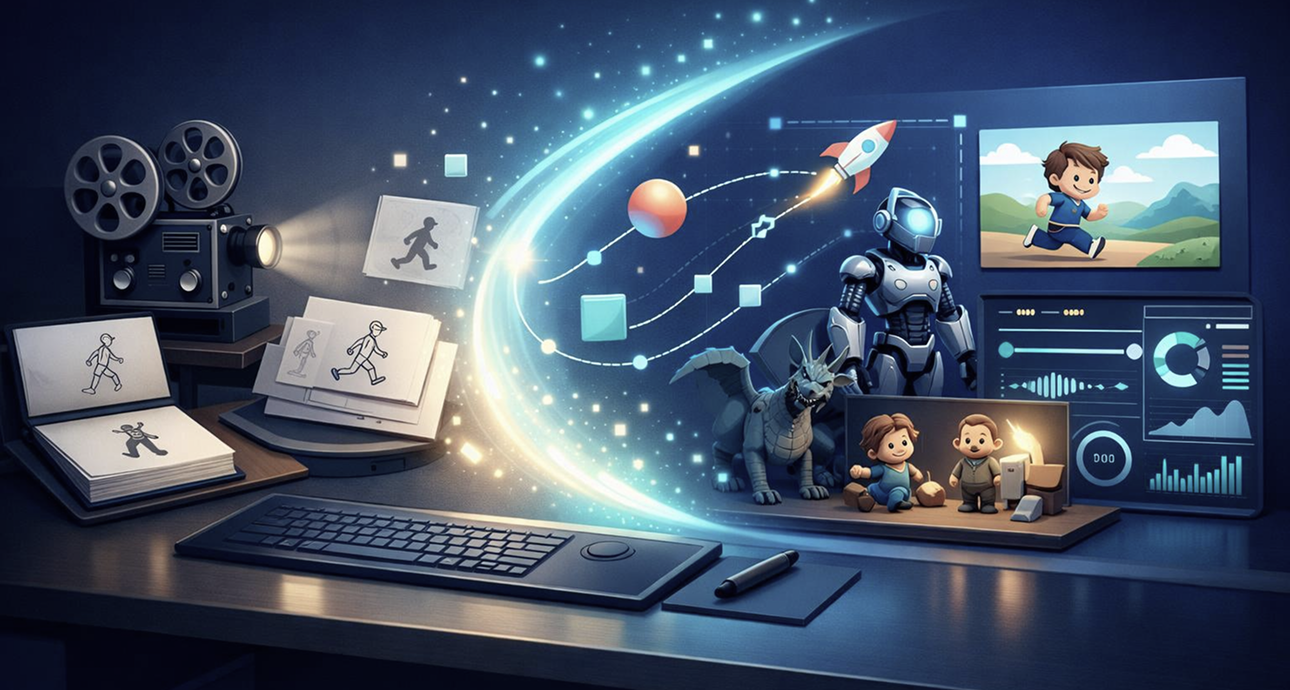
Animation is a powerful visual communication technique that allows creators and businesses to bring ideas, stories, and concepts to life. Today, animation is used far beyond cartoons and movies. It plays a major role in marketing, education, mobile applications, user experience design, simulations, and immersive entertainment.
This detailed guide explains what animation is, how animation works, the complete history of animation, and all major types of animation, including advanced formats such as 4D and 5D animation.
What is Animation?
Animation is the process of creating the illusion of movement by displaying a series of still images rapidly, where each image is slightly different from the one before it. When these images are shown in sequence, the human brain perceives them as continuous motion.
In simple words, animation makes still images look like they are moving.
Animation is widely used in:
- Animated movies and TV shows
- Advertisements and explainer videos
- Websites and mobile applications
- Video games and simulations
- Education, training, and business communication
Unlike static images, animation can show motion, emotion, transformation, and processes, making it one of the most effective tools for visual storytelling.
How Does Animation Work?
Animation works because of how the human eye and brain process images. The key concept behind animation is called persistence of vision.
Persistence of Vision
Persistence of vision means that the human eye retains an image for a short moment even after it disappears. When multiple images are shown quickly, the brain blends them together, creating smooth motion.
Key Elements of Animation
Animation is built using the following core elements:
Frames
A frame is a single still image. Animation is created by showing many frames one after another.
Frame Rate (FPS)
FPS means frames per second. Common frame rates include:- 12 FPS – basic or limited animation
- 24 FPS – cinematic standard
- 30 FPS – smooth digital animation
- 60 FPS – games and simulations
Timing
Timing controls how fast or slow an object moves. Good timing makes animation look natural.
Spacing
Spacing controls how movement accelerates or slows down, adding realism.
Basic Animation Workflow
Most animation projects follow this step-by-step process:
- Idea and concept
- Script writing
- Storyboarding
- Character and asset design
- Animation production
- Sound design and effects
- Final rendering and delivery
History of Animation
Animation has a long history that evolved over time with technology and creativity.
Early Beginnings of Animation
Before films existed, early humans experimented with motion using simple visual tricks. In the 19th century, devices such as flipbooks and zoetropes were invented to create the illusion of movement.
Key characteristics of early animation:
- Mechanical and manual techniques
- Simple repetitive motion
- No sound or color
These early experiments laid the foundation for modern animation.
Traditional Animation Era
In the early 20th century, animation became a recognized art form. Artists began drawing each frame by hand on paper or transparent sheets called animation cels.
This era introduced:
- Hand-drawn cartoons
- Frame-by-frame storytelling
- Classic animated films
Traditional animation required thousands of drawings for just a few minutes of animation.
Digital Animation Revolution
The introduction of computers completely transformed animation. Digital tools replaced paper, making animation faster, more flexible, and scalable.
Major advancements included:
- Digital 2D animation
- Computer-generated imagery (CGI)
- 3D modeling and rendering
- Realistic lighting and physics
Today, most animation is created using digital software.
Types of Animation (Detailed Explanation)
Animation can be created in many different ways depending on the style, tools, purpose, and audience. Each type of animation has its own process, advantages, and use cases. Below is a complete and detailed explanation of the most important types of animation used today.
1. Traditional Animation (Hand-Drawn Animation)
Traditional animation is the oldest form of animation. In this method, every single frame is drawn by hand, showing small changes in movement.
How Traditional Animation Works
- Artists draw characters and scenes on paper
- Each drawing represents one frame
- Thousands of drawings are created for a few minutes of animation
- Frames are photographed or scanned and played in sequence
Key Characteristics
- Fully hand-drawn and artistic
- Extremely time-consuming
- Requires strong drawing and storytelling skills
Where It Is Used
- Classic animated films
- Artistic and creative projects
- Animation training and education
Traditional animation is respected for its creativity and craftsmanship, even though it is rarely used for large-scale production today.
2. 2D Animation
2D animation uses flat, two-dimensional visuals created digitally using animation software. Characters and objects move only on horizontal (X) and vertical (Y) axes.
How 2D Animation Works
- Characters are designed digitally
- Movement is created using keyframes
- Software handles in-between frames
- Backgrounds and characters are layered
Advantages of 2D Animation
- Cost-effective compared to 3D
- Faster production time
- Easy to update and edit
- Works well for storytelling and explanations
Common Use Cases
- Explainer videos
- Educational content
- Marketing and advertising
- Social media videos
- Startup and SaaS promotions
2D animation is one of the most popular animation styles for businesses and digital marketing.
3. 3D Animation
3D animation creates objects and characters in a three-dimensional digital environment. Unlike 2D, it adds depth (Z-axis), making visuals more realistic.
How 3D Animation Works
- 3D models are created using software
- Textures and materials are applied
- Characters are rigged with digital skeletons
- Animators create movement
- Lighting and rendering produce final visuals
Key Features
- Realistic depth and motion
- Cinematic camera angles
- High visual quality
Common Use Cases
- Movies and TV shows
- Video games
- Product visualization
- Architecture and real estate
- Medical and technical animations
3D animation is ideal when realism and immersion are required.
4. 4D Animation
4D animation takes 3D animation one step further by adding physical effects that the audience can feel.
What Makes Animation “4D”?
The fourth dimension refers to physical sensations, not visuals.
Common 4D Effects
- Moving seats
- Wind and air effects
- Water sprays
- Vibrations
- Surround sound
Where 4D Animation Is Used
- Theme parks
- Immersive cinemas
- Special attraction rides
4D animation enhances the viewing experience by engaging the audience’s body along with visuals.
5. 5D Animation
5D animation is an advanced and immersive animation experience that combines visuals, physical effects, and environmental interaction.
What is 5D Animation?
5D animation includes:
- 3D animated visuals
- 4D physical effects
- Environmental elements like lighting, motion, and vibration
- Multi-sensory audience engagement
Difference Between 4D and 5D Animation
- 4D focuses mainly on physical effects
- 5D focuses on full immersion and interaction
Common Use Cases
- Simulation rides
- Experiential marketing
- Virtual entertainment venues
- Advanced theme park attractions
5D animation is designed to make the audience feel completely inside the experience.
6. Motion Graphics Animation
Motion graphics animation focuses on animated text, icons, shapes, and graphic elements rather than characters.
Key Characteristics
- Clean and professional design
- Focused on information delivery
- Short and engaging
Common Uses
- Corporate videos
- Product demos
- Advertisements
- App and website UI animations
- Presentations
Motion graphics are ideal for explaining data, concepts, and messages quickly.
7. Stop Motion Animation
Stop motion animation is created using physical objects that are photographed frame by frame.
How Stop Motion Works
- An object is moved slightly
- A photo is taken
- The process is repeated many times
- Photos are played in sequence
Key Features
- Handmade and unique style
- Highly creative
- Very time-intensive
Common Uses
- Artistic films
- Commercials
- Creative storytelling projects
Stop motion animation is popular for its distinct and tactile look.
8. Whiteboard Animation
Whiteboard animation shows illustrations being drawn in real time, usually on a white background.
Key Benefits
- Easy to understand
- Highly engaging
- Strong educational value
Common Use Cases
- Training videos
- Tutorials
- Educational explainers
- Corporate learning content
Whiteboard animation is effective for teaching and explaining concepts step by step.
9. Cut-Out Animation
Cut-out animation uses flat characters or objects that are moved frame by frame.
Characteristics
- Simple and minimal design
- Budget-friendly
- Can be traditional or digital
Where It Is Used
- Educational content
- Low-budget animation projects
- Creative storytelling
10. Rotoscope Animation
Rotoscope animation is created by tracing over live-action footage to achieve realistic motion.
Key Benefits
- Natural and realistic movement
- Combines live action with animation
Common Uses
- Films
- Music videos
- Artistic and experimental projects
11. Experimental & Hybrid Animation
Hybrid animation combines multiple animation styles into one project.
Characteristics
- Mix of 2D, 3D, motion graphics, and live action
- High creative freedom
- Unique visual storytelling
Use Cases
- Modern digital media
- Artistic films
- Creative brand campaigns
Uses of Animation Across Industries (Detailed Explanation)
Animation is no longer limited to cartoons and movies. Today, it is a critical tool used across almost every industry to communicate ideas, explain complex concepts, engage audiences, and improve user experience. Because animation combines visuals, motion, and storytelling, it works effectively in both creative and business environments.
Below is a detailed breakdown of how animation is used across different industries.
1. Entertainment and Media Industry
The entertainment industry is one of the oldest and largest users of animation. Animation plays a key role in storytelling, world-building, and visual creativity.
How Animation Is Used
- Animated movies and TV shows
- Visual effects (VFX) in films
- Video games and cinematic cutscenes
- Streaming platform content
Why Animation Is Important
- Allows unlimited creative freedom
- Makes impossible scenes possible
- Appeals to all age groups
- Enhances emotional storytelling
Animation enables creators to build entire worlds that cannot exist in real life.
2. Marketing and Advertising Industry
Animation is widely used in marketing because it grabs attention quickly and communicates messages clearly.
Common Uses
- Explainer videos
- Social media ads
- Brand story videos
- Product launch videos
- Motion graphic ads
Benefits for Marketing
- Higher engagement rates
- Better message retention
- Easy to explain complex products
- Works well across digital platforms
Many US brands prefer animation for digital marketing because it delivers faster and clearer results.
3. Education and eLearning Industry
Animation has transformed education by making learning more visual and interactive.
How Animation Is Used
- Online courses and eLearning modules
- Educational explainer videos
- Whiteboard animations
- Interactive learning apps
Why Animation Works in Education
- Simplifies complex topics
- Improves understanding and retention
- Keeps learners engaged
- Suitable for all age groups
Animation helps learners visualize abstract concepts like science, math, and technology.
4. Business and Corporate Industry
Businesses use animation to communicate ideas internally and externally.
Common Business Uses
- Corporate presentations
- Training and onboarding videos
- Company overview videos
- Internal communication content
Business Benefits
- Saves time compared to live training
- Standardizes communication
- Improves employee engagement
- Professional brand image
Animation allows businesses to explain processes clearly and consistently.
5. Technology and SaaS Industry
The tech industry relies heavily on animation to explain digital products and software.
How Animation Is Used
- Product explainer videos
- UI and UX animations
- App walkthroughs
- Feature demonstration videos
Why Animation Is Important for Tech
- Explains complex software easily
- Improves user onboarding
- Enhances user experience
- Reduces support queries
Most SaaS companies use animated videos to improve conversions and user adoption.
6. Healthcare and Medical Industry
Animation plays a critical role in medical education, training, and patient communication.
Common Uses
- Medical procedure animations
- Patient education videos
- Anatomy and biology visuals
- Training simulations
Benefits
- Explains medical concepts visually
- Improves patient understanding
- Reduces fear and confusion
- Supports accurate training
Medical animation helps bridge the gap between complex science and human understanding.
7. Architecture, Engineering, and Real Estate
Animation is used to visualize structures before they are built.
How Animation Is Used
- 3D walkthroughs
- Architectural visualizations
- Construction process animations
- Real estate marketing videos
Advantages
- Helps clients visualize projects
- Improves decision-making
- Saves time and cost
- Enhances presentations
3D animation allows stakeholders to see designs in a realistic way before construction begins.
8. Manufacturing and Industrial Sector
Animation is used to explain machinery, processes, and workflows.
Common Uses
- Product assembly animations
- Process simulations
- Safety training videos
- Equipment demonstrations
Why Animation Is Effective
- Explains complex machinery
- Improves safety training
- Reduces training errors
- Saves operational costs
Industrial animation is especially useful for technical and safety-related communication.
9. Gaming and Interactive Media
The gaming industry depends heavily on animation for character movement and immersive gameplay.
Uses in Gaming
- Character animation
- Environment animation
- Cutscenes and cinematics
- User interface animations
Importance
- Creates immersive experiences
- Improves realism
- Enhances player engagement
Animation is the backbone of modern video games.
10. E-Commerce and Retail Industry
Animation helps online businesses showcase products more effectively.
How Animation Is Used
- Product demo videos
- 360-degree product views
- Promotional animations
- Interactive ads
Benefits
- Increases product understanding
- Builds customer trust
- Improves conversion rates
Animated product videos help customers make confident buying decisions.
11. Finance and Fintech Industry
Financial concepts can be complex, and animation helps simplify them.
Common Uses
- Financial explainer videos
- App onboarding animations
- Investment education content
Benefits
- Simplifies technical information
- Builds trust and credibility
- Improves user engagement
Fintech companies often use animation to educate users and promote services.
12. Tourism, Events, and Theme Parks
Animation enhances experiences in tourism and live attractions.
How Animation Is Used
- Promotional travel videos
- Theme park attractions
- 4D and 5D immersive experiences
Benefits
- Creates memorable experiences
- Enhances visitor engagement
- Supports experiential marketing
Animation helps brands create emotional and immersive experiences.
Animation vs Live Action
| Animation | Live Action |
|---|---|
| Unlimited creativity | Real-world limits |
| Explains complex ideas | Best for realism |
| Scalable and reusable | Location dependent |
| Cost-effective long-term | Higher logistics |
Why is Animation Important for Businesses? (Detailed Explanation)
In today’s fast-paced digital world, businesses need to communicate their message quickly, clearly, and effectively. Customers have limited attention spans, and traditional text or static images are often not enough to explain products or services. This is where animation becomes extremely valuable for businesses.
Animation helps businesses explain complex ideas, engage audiences, build brand identity, and drive conversions across multiple platforms.
1. Animation Grabs Attention Quickly
One of the biggest challenges for businesses is capturing attention in a crowded digital space. Animation uses motion, color, and storytelling, which naturally attracts the human eye.
Why This Matters
- Moving visuals stand out more than static content
- Users stop scrolling when they see animation
- Higher engagement on websites and social media
Animation helps businesses make a strong first impression within seconds.
2. Animation Simplifies Complex Ideas
Many businesses offer products or services that are difficult to explain using text alone, especially in industries like technology, finance, healthcare, and SaaS.
How Animation Helps
- Breaks complex concepts into visual steps
- Uses storytelling to explain processes
- Makes technical information easy to understand
This is why explainer videos are widely used by startups and enterprise companies in the US.
3. Improves Customer Engagement and Retention
Engaged users are more likely to remember a brand and take action. Animation keeps viewers interested by combining visuals, motion, and sound.
Business Benefits
- Longer time spent on websites
- Better message retention
- Increased user interaction
Animated content helps businesses communicate messages in a more memorable way.
4. Increases Conversion Rates
Animation is proven to improve conversion rates when used strategically on landing pages, product pages, and marketing campaigns.
How Animation Drives Conversions
- Explains value quickly
- Builds trust through clarity
- Reduces confusion and hesitation
Many businesses see higher sign-ups and sales after adding animated explainer videos.
5. Strengthens Brand Identity
Animation allows businesses to express their brand personality consistently across platforms.
Brand Building Advantages
- Custom characters and visuals
- Consistent colors, fonts, and motion style
- Strong emotional connection with audience
Animated branding helps businesses stand out from competitors.
6. Cost-Effective and Scalable Marketing
Compared to live-action video, animation is often more cost-effective in the long run.
Why Animation Saves Money
- No need for actors, locations, or sets
- Easy to update content
- Reusable across multiple platforms
Businesses can use the same animated video for websites, ads, presentations, and social media.
7. Works Across Multiple Digital Platforms
Animation adapts easily to different formats and screen sizes.
Where Businesses Use Animation
- Websites and landing pages
- Social media platforms
- Mobile apps
- Email marketing
- Presentations and pitches
Animated content ensures consistent messaging everywhere.
8. Improves User Experience (UX)
Animation enhances how users interact with digital products.
UX Benefits
- Smooth transitions
- Clear visual feedback
- Guided user actions
Well-designed animation makes apps and websites easier and more enjoyable to use.
9. Builds Trust and Credibility
Professional animation reflects quality and attention to detail.
Why Trust Matters
- Clear explanations reduce doubt
- Polished visuals create confidence
- Educational animation positions brands as experts
Businesses that educate their audience gain long-term trust.
10. Supports Sales, Training, and Internal Communication
Animation is not just for marketing — it’s also powerful for internal use.
Internal Business Uses
- Employee training videos
- Onboarding content
- Process explanations
- Sales presentations
Animated training reduces errors and saves time.
11. Helps Businesses Stay Competitive
Many businesses already use animation as part of their digital strategy. Companies that ignore animation risk falling behind.
Competitive Advantages
- Modern brand image
- Better digital presence
- Stronger customer engagement
Animation helps businesses stay relevant in evolving markets.
12. Supports Advanced Experiences (4D & 5D Animation)
For experiential marketing and entertainment businesses, advanced animation offers unique opportunities.
Advanced Uses
- 4D immersive experiences
- 5D interactive environments
- Simulation and experiential marketing
These experiences create strong emotional connections with audiences.
Future of Animation (Detailed Explanation)
The future of animation is driven by rapid technological advancement, changing audience behavior, and increasing demand for immersive digital experiences. Animation is no longer limited to films and cartoons; it is becoming a core part of marketing, education, technology, entertainment, and interactive media.
Below is a detailed explanation of the key trends and directions shaping the future of animation.
1. Artificial Intelligence (AI) in Animation
Artificial Intelligence is transforming how animation is created by automating complex and time-consuming tasks.
How AI Is Changing Animation
- Auto-generating in-between frames
- Facial expression and lip-sync automation
- AI-assisted character movement
- Faster rendering and scene optimization
Benefits of AI Animation
- Reduced production time
- Lower costs
- Faster revisions
- More creative freedom for artists
AI does not replace animators but helps them work smarter and faster.
2. Real-Time Animation and Rendering
Real-time rendering allows animators to see final-quality visuals instantly, instead of waiting hours or days for rendering.
Key Developments
- Game engines used for animation
- Instant lighting and shadow previews
- Real-time camera movement
Why It Matters
- Faster production workflows
- Live animation previews
- Ideal for virtual production and live events
Real-time animation is especially important for gaming, virtual events, and interactive experiences.
3. Growth of 3D, 4D, and 5D Animation
Advanced animation formats are becoming more common as audiences demand immersive experiences.
What’s Changing
- More realistic 3D visuals
- Increased use of physical effects (4D)
- Growth of immersive 5D experiences
Where It’s Used
- Theme parks and attractions
- Experiential marketing
- Simulation and training environments
Immersive animation focuses on engaging all senses, not just sight.
4. Augmented Reality (AR) and Virtual Reality (VR)
AR and VR are redefining how people interact with animated content.
AR Animation
- Overlays digital animation onto the real world
- Used in mobile apps, retail, and education
VR Animation
- Fully immersive digital environments
- Used in gaming, training, and virtual tours
Benefits
- Higher engagement
- Interactive storytelling
- Real-world application
AR and VR animation will continue to grow as hardware becomes more accessible.
5. Interactive and User-Controlled Animation
The future of animation is not just about watching — it’s about interacting.
Key Features
- User-driven storytelling
- Clickable and responsive animations
- Branching narratives
Use Cases
- Interactive ads
- Educational simulations
- Training programs
- Games and digital experiences
Interactive animation increases engagement and personalization.
6. Animation in Marketing and Business Communication
Animation will continue to play a bigger role in business strategy.
Business Trends
- Personalized animated content
- Data-driven animation
- Short-form animated ads
Why Businsses Will Use More Animation
- Higher ROI
- Better audience retention
- Easier explanation of digital products
Animation will remain a key tool for brand communication.
7. Short-Form and Social Media Animation
Social media platforms are pushing demand for short, engaging animated content.
Key Trends
- Animated reels and stories
- Motion graphics for social ads
- Loop-based animations
Benefits
- Fast consumption
- Mobile-friendly
- High engagement
Short-form animation is becoming essential for digital marketing.
8. Cloud-Based Animation Production
Cloud technology is changing how animation teams collaborate.
Advantages
- Remote collaboration
- Cloud rendering
- Easy file sharing
Impact on Industry
- Global animation teams
- Faster project delivery
- Reduced hardware costs
Cloud-based animation supports scalable production.
9. Hyper-Realistic Animation
Advancements in technology are pushing animation toward realism.
What’s Improving
- Realistic facial animation
- Physics-based motion
- Advanced lighting and textures
Use Cases
- Films and games
- Medical and scientific visualization
- Product demonstrations
Hyper-realism increases trust and immersion.
10. Ethical and Responsible Animation
As animation becomes more powerful, ethical considerations are becoming important.
Key Concerns
- AI-generated content transparency
- Responsible use of deepfake technology
- Representation and inclusivity
Future animation will focus on responsible and ethical creation.
11. Animation as a Career and Industry Growth
The animation industry is growing rapidly worldwide.
Industry Growth Areas
- Animation for business and SaaS
- Educational animation
- AR/VR animation
- Game development
Career Opportunities
- 2D and 3D animators
- Motion designers
- Technical animators
- Animation directors
Animation will continue to offer strong career opportunities.
Conclusion
Animation has evolved from simple drawings into advanced immersive experiences. Understanding animation, its history, and its types helps creators and businesses choose the right animation style for their goals.
From 2D explainer videos to 5D immersive environments, animation continues to shape digital communication.