
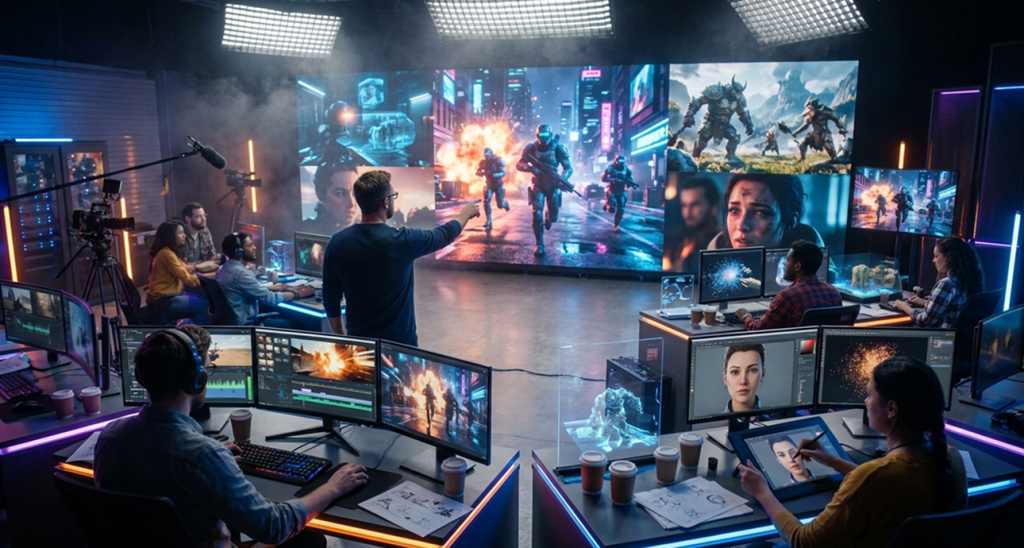
Game trailers have become one of the most powerful marketing tools in the entertainment industry. A single trailer released at the right moment can drive millions of views, dominate social media, and push pre-orders before a game ever ships. Across the USA, studios that invest in professional cinematic trailer animation and partner with a trusted mobile game animation company USA consistently outperform those that cut corners on this stage.
The standard has risen sharply over the past several years. Players are visually sophisticated and form opinions about a game’s quality within the first few seconds of watching. Meeting that expectation requires expert animation, precise storytelling, and cinematic craft that goes far beyond a screen recording.
Evolution of Modern Game Trailers
From Feature Lists to Emotional Stories
Game trailers began as simple gameplay demonstrations designed to show mechanics and features. Early trailers were functional rather than emotional. They served as product previews rather than standalone cinematic experiences.
The landscape shifted as gaming grew into a mainstream cultural force. Publishers began treating trailers as creative content in their own right. They hired directors, composers, and animation studios to craft sequences that could stand alongside Hollywood productions.
How Distribution Has Changed Everything
Today, game trailer animation services USA cover everything from fully rendered cinematics to hybrid presentations that blend in-game footage with purpose-built animated storytelling. Each format serves a different goal. Choosing the right one requires a clear understanding of the audience and the game’s identity.
The social media era has pushed trailers toward shorter, more impactful formats as well. Studios now produce multiple versions of the same trailer cut for different platforms. This variety requires planning from the very beginning of production.
How Trailers Have Shifted Over Time
- Early trailers focused on showing mechanics and features directly to potential buyers
- Mid-generation trailers introduced scripted cinematics alongside raw gameplay footage
- Modern trailers often lead with fully animated sequences before showing gameplay at all
- Emotional storytelling has replaced feature lists as the primary marketing driver
- Vertical and short-form formats are now produced in parallel for social media distribution
How Cinematic Trailers Boost Game Marketing
The Power of Emotional Connection
A professionally produced cinematic trailer does more than show what a game looks like. It creates an emotional connection between a potential player and the world of the game. That emotional investment drives shares, discussions, and purchases in ways that gameplay demonstrations rarely achieve.
Trailers that perform well in marketing share specific qualities. They open with a hook that captures attention within the first few seconds. They build tension or curiosity through deliberate pacing. They resolve with a moment that leaves the viewer wanting more.
Why AAA Studios Invests So Heavily
AAA game trailers from major publishers demonstrate the commercial power of this approach time and again. Games that launch with a strong cinematic trailer regularly outperform their pre-launch projections. The reason is simple. Great trailers build genuine anticipation rather than just informing.
Indie studios that invest in similar quality gain access to the same audience response at a smaller scale. A well-crafted cinematic trailer signals production quality and credibility. It tells players and press alike that the studio takes their work seriously.
What a Strong Cinematic Trailer Achieves
- Establishes tone, world, and emotional stakes of the game in the first few seconds
- Creates shareable moments that spread organically across social media platforms
- Signals production quality and builds trust with players and the press simultaneously
- Differentiates the title from competitors in a crowded release schedule
- Drives pre-orders, wishlists, and community growth before the game launches
Popular Trends in Game Trailer Animation
The Rise of Stylised and Hybrid Formats
The visual style of game trailers has diversified significantly over recent years. Rather than following a single cinematic template, studios are exploring a wider range of animation styles. This flexibility allows titles with distinctive art directions to stand out more effectively.
Stylised animation has gained strong traction as an alternative to photorealistic rendering. Games with bold, graphic visual styles often produce more memorable trailers when they lean into their distinctiveness. This approach attracts the right audience more efficiently.
3D Remains the Standard for Major Releases
3D game trailer animation remains the dominant format for major releases targeting console and PC platforms. The combination of high-resolution rendering, advanced lighting, and fluid character animation creates the filmic quality audiences now associate with premium games.
Hybrid formats have also grown in popularity. These blend purpose-built rendered cinematics with real-time engine footage. This approach delivers cinematic impact while also showing players what the actual game looks and feels like.
Current Trends Shaping Trailer Production
- Stylised 2D animation used to highlight unique and distinctive art directions
- Hybrid trailers blending rendered cinematics with real-time in-engine footage
- Shorter vertical formats produced specifically for mobile and social media platforms
- Narrative-driven sequences that prioritise story and character over feature showcasing
- Dynamic music and sound design are used as primary emotional drivers throughout
Benefits of Professional Trailer Animation
What Professional Production Actually Delivers
The difference between a professional production and an amateur one is immediately visible to audiences. Professional studios bring technical capability, storytelling experience, and creative discipline that translate directly into stronger audience response.
Working with a professional game trailer studio also removes a significant burden from the development team. Game studios are built for making games, not for producing marketing content. Trying to create a cinematic trailer with the same team that is deep in production almost always produces something that serves neither goal well.
Platform Expertise and Measurable ROI
Professional studios understand distribution requirements across different platforms. A trailer built for YouTube needs different pacing and framing than one designed for TikTok or Instagram. Managing these differences requires experience that most internal teams simply do not have at hand.
The return on investment is also measurable. Studios that invest in professional trailer animation consistently see stronger launch results. Better trailers generate more press coverage, more community discussion, and more day-one sales.
Advantages of Hiring a Professional Trailer Studio
- Access to specialised animators, directors, and sound designers under one roof
- Faster production timelines thanks to established and rehearsed workflows
- Content optimised simultaneously for multiple distribution platforms and formats
- An objective, creative perspective that serves the audience rather than internal preferences
- Higher production value that signals credibility to both publishers and players
2D vs 3D Cinematic Game Trailers
Choosing the Right Visual Approach
Choosing between 2D and 3D animation for a game trailer is a creative and strategic decision. Both approaches can produce exceptional results. They simply serve different purposes and communicate different things about a game’s identity.
3D cinematic animation is the standard for games with realistic or semi-realistic visual styles. It produces the filmic depth and lighting that audiences associate with high-budget productions. The rendering process takes longer and requires more resources, but the output matches the visual language of premium gaming content.
When 2D Wins
2D animation offers a strong advantage for games built around a stylised aesthetic. A well-crafted 2D trailer can be equally stunning and often more memorable because of its visual distinctiveness. Production is generally faster and more accessible, which makes it a compelling option for indie developers with focused budgets.
2D vs 3D Trailer Comparison
| Factor | 2D Cinematic Trailer | 3D Cinematic Trailer |
| Visual Style | Stylised and graphic | Realistic or semi-realistic |
| Production Time | Generally faster | Longer due to rendering |
| Cost | More accessible | Higher investment |
| Best For | Indie and stylised games | AAA and realistic titles |
| Audience Perception | Distinctive and artistic | Premium and cinematic |
| Platform Fit | Social media and indie stores | Console, PC, and major platforms |
Role of Unreal Engine in Cinematic Game Trailers Services
Real-Time Rendering Changes the Game
Unreal Engine has fundamentally changed how cinematic game trailers are produced. Its real-time rendering capabilities allow studios to create near-photorealistic sequences at a fraction of the time required by traditional offline pipelines. This shift has made high-quality trailer production more accessible across different studio sizes.
The Sequencer tool inside Unreal enables complex cinematic setups with camera animations, lighting rigs, and character performances. These can all be previewed and adjusted in real time without waiting for long render passes. This interactivity speeds up the creative process considerably.
Why Clients Request Unreal-Based Production
For studios providing game trailer animation services USA, Unreal Engine expertise has become a core competency. Clients increasingly expect Unreal-based production because of the visual fidelity it delivers. The ability to reuse in-game assets directly inside the trailer pipeline is another major practical advantage.
Lumen and Nanite technologies available in recent Unreal versions have pushed visual fidelity even further. These tools allow studios to achieve lighting and geometry complexity that was previously impossible in real time. As a result, the gap between real-time and offline-rendered cinematics continues to narrow.
Why Unreal Engine Matters for Trailer Production
- Real-time rendering dramatically reduces production timelines and iteration costs
- In-game assets can be imported directly to ensure visual consistency with the actual game
- Advanced lighting and post-processing tools produce genuine cinematic-quality output
- Sequencer allows complex multi-camera setups and performative animated scenes
- Lumen and Nanite deliver visual fidelity that approaches offline rendering standards
Get Cinematic Trailer Services
What Split Arts Brings to Every Project
Split Arts delivers cinematic game trailer animation for studios across the USA. The team combines artistic direction, technical animation, and deep engine expertise to produce trailers that connect with audiences and drive real marketing results.
Whether you need a fully rendered 3D cinematic, a stylised 2D animated trailer, or a hybrid production that blends both, Split Arts has the pipeline and the talent to handle it. Every trailer is built around your game’s specific identity and the audience you need to reach.
Ready to Start Your Trailer Project
As a leading provider of game trailer animation services in the USA, Split Arts works with indie developers, mid-market studios, and major publishers across the country. The process is collaborative, deadline-focused, and designed to produce content that performs across every platform your marketing team needs.
Reach out today to discuss your game, your timeline, and how a professionally produced cinematic trailer can give your launch the momentum it deserves.
Frequently Asked Questions
What is cinematic game trailer animation?
Cinematic game trailer animation refers to purpose-built animated sequences created specifically for marketing a game. These sequences are designed separately from gameplay footage and built to tell a story, establish tone, or showcase characters in a visually compelling and emotionally resonant way.
How long does it take to produce a cinematic game trailer?
A fully rendered 3D cinematic of sixty to ninety seconds typically requires six to twelve weeks from concept to final delivery. Simpler 2D trailers can be completed more quickly, depending on the scope and the number of revision rounds required throughout the process.
Is Unreal Engine the best tool for cinematic trailer production?
Unreal Engine is currently the most widely used tool for real-time cinematic production and delivers exceptional visual quality with faster render times than traditional pipelines. The best tool ultimately depends on the visual style of the game and the specific requirements of each trailer.
What is the difference between a cinematic trailer and a gameplay trailer?
A cinematic trailer is a purpose-built animated sequence that prioritises story and emotion over direct gameplay demonstration. A gameplay trailer shows actual in-game footage to communicate mechanics and visual fidelity. Many studios use both formats at different stages of their marketing campaign.
Can indie studios afford professional cinematic trailer animation?
Yes. With 2D animation or Unreal Engine-based production, professional-quality results are achievable at more accessible price points. Split Arts works with studios of all sizes and can tailor the production scope to match your budget while maintaining the visual quality needed to compete for audience attention.
How important is a game trailer for launch success?
A strong trailer is often the single most influential marketing asset a game has. It drives wishlists, social shares, media coverage, and pre-orders before the game is even playable. Studios that invest in professional trailer production consistently see stronger launch results than those relying on in-house or non-specialist production.
Final Thoughts
Cinematic game trailer animation has become a defining factor in how games are received before they reach a player’s hands. The bar is high, the competition is fierce, and audiences respond to quality immediately.
Split Arts brings the expertise, the technology, and the creative direction needed to produce trailers that make a lasting impact. Reach out today to start building the marketing content your game truly deserves.