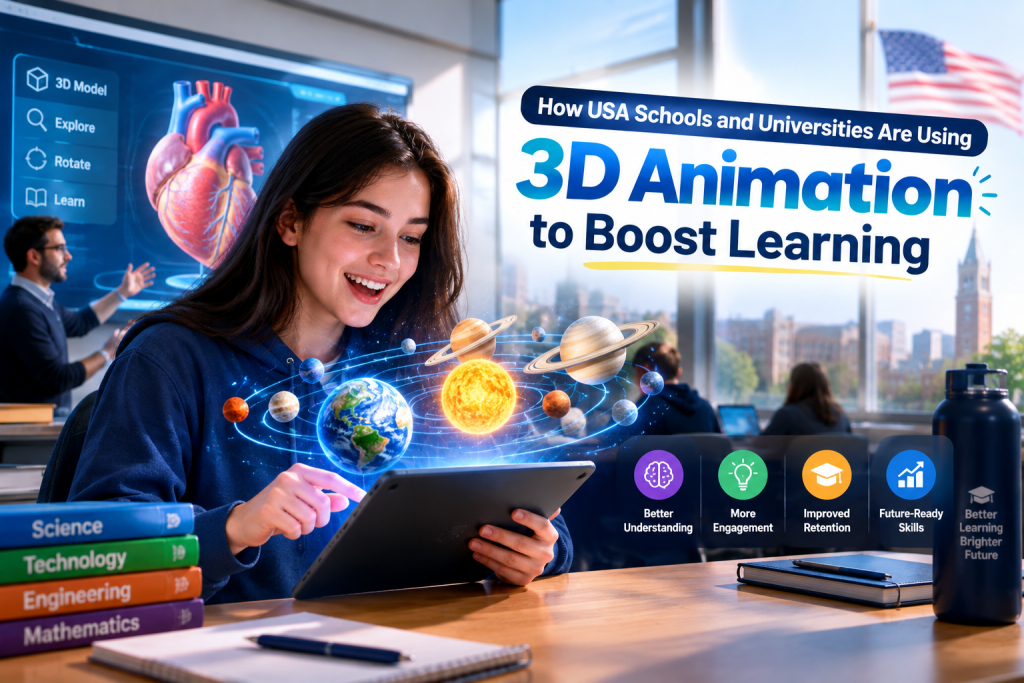
Remember sitting in class staring at a textbook diagram of the human heart?
Static lines, confusing labels, and exactly zero understanding of how blood actually flows through chambers.
Now imagine watching that same heart beat in 3D. Watching valves open and close in real-time. Seeing oxygenated blood glow red as it pulses through arteries. Suddenly anatomy isn’t abstract anymore. It’s alive.
That’s the energy 3d animation services USA educators are bringing into classrooms right now. And no, it’s not just fancy tech for fancy schools. It’s becoming the baseline for how modern education actually works.
From K-12 districts to Ivy League lecture halls, teachers are ditching flat diagrams for immersive 3D experiences that make students lean forward instead of zone out.
Why Are USA Schools Adopting 3D Animation
The TikTok Generation Doesn’t Do Textbooks
Let’s be honest about who sits in classrooms today. These are kids who grew up on YouTube, TikTok, and video games with cinematic cutscenes. Their brains are wired for motion, color, and interactivity.
Handing them a fifty-page PDF and expecting engagement is like asking someone who watches Netflix to read a radio transcript. It technically contains the same information, but the delivery format is completely mismatched to how they process content.
Consequently, schools across the USA are realizing that traditional teaching methods aren’t failing because the material is hard. They’re failing because the delivery is boring. And in 2026, boring is the enemy of learning.
The Post-Pandemic Reality Check
Remote learning forced every educator to confront a brutal truth. If your lesson doesn’t hold attention through a screen, it doesn’t hold attention at all.
Schools that invested in dynamic digital content during the pandemic saw higher engagement and better test scores. Schools that didn’t? They watched participation rates plummet and never fully recover.
Furthermore, the bar for educational content has been permanently raised. Students now expect learning to feel as polished as the content they consume for fun. Top Animation Services Company USA teams are helping schools meet that bar without breaking their budgets.
How Does 3D Animation Improve Learning Outcomes
When Students Actually Remember Stuff
Here’s a stat that should live rent-free in every educator’s head. People remember about 10% of what they read, 20% of what they hear, but 65% of what they see and do. 3D animation bridges that gap by turning passive reading into active visual processing.
When a student watches a molecular reaction happen in three dimensions, their brain encodes it as an experience, not just information.
That encoding difference is everything. It’s the difference between cramming for a test and forgetting it the next day versus actually understanding a concept for years.
Retention That Hits Different
Research consistently shows that visual and interactive learning improves retention by 30% to 50% compared to text-based instruction alone. That’s not a small bump. That’s a fundamental shift in how much students actually carry with them.
Schools using 3D animation report that students recall complex concepts weeks and months after initial exposure. Because when you see a 3D model of tectonic plates shifting, you don’t just memorize the vocabulary. You understand physics.
How Does 3D Animation Simplify Complex Subjects
From Abstract to “Oh, I See It”
Some subjects are just inherently hard to teach with words. Quantum mechanics. DNA replication. Calculus. Climate systems. These are concepts that exist in multiple dimensions, across time, and at scales too big or small to visualize normally.
3D animation solves this by making the invisible visible. You can fly inside a cell. You can orbit a molecule. You can watch a glacier form and melt over a thousand years in thirty seconds.
Moreover, students don’t need to decode complex language to understand what’s happening. The visual narrative does the heavy lifting. A struggling reader and a gifted student can both grasp the same concept because the animation speaks a universal language.
Breaking Down Barriers
Complex subjects often create anxiety. Students decide early that they’re “not a math person” or “bad at science” because the initial explanation felt impossible.
3D animation removes that intimidation factor. It presents hard concepts as approachable, even beautiful. When a student feels like they “get it,” their confidence builds. And confidence is the secret ingredient that turns struggling learners into engaged ones.
Does 3D Animation Boost Student Engagement
Engagement That Hits Different
Anyone who’s stood in front of a classroom knows the look. Eyes glazed, phones under desks, minds a thousand miles away. Engagement isn’t about discipline. It’s about making content impossible to ignore.
3D animation creates what educators call “productive fascination.” Students aren’t just watching. They’re leaning in, pointing at screens, asking questions, and actually caring about what comes next.
That level of engagement isn’t just nice to have. It’s the difference between a student who completes assignments and one who drops out mentally before they drop out physically.
The Participation Ripple
When one student gets excited by a 3D animation, it spreads. Classmates who were checked out suddenly want to know what’s happening. The quiet kid in the back raises their hand for the first time all semester.
This ripple effect transforms classroom culture. Lessons stop feeling like lectures and start feeling like shared experiences. And shared experiences create the kind of classroom environments where real learning happens.
How Do USA Schools Use It for Science Education
Science Class But Make It Cinematic
Science education is where 3D animation absolutely shines. Biology, chemistry, physics, astronomy, these are all visual subjects that have been trapped in flat diagrams for way too long.
USA schools are using 3D animation to let students explore the inside of a human cell, watch chemical bonds form and break, or travel through the solar system at light speed. It’s not a replacement for labs. It’s a bridge that makes labs make sense.
| Science Subject | Traditional Method | With 3D Animation |
| Biology | Static cell diagrams | Fly-through of organelles in action |
| Chemistry | 2D molecular formulas | Animated bond formation and reactions |
| Physics | Math equations on board | Visualized forces and motion in 3D space |
| Astronomy | Textbook photos of planets | Orbital simulations and scale comparisons |
| Anatomy | Cadaver photos or illustrations | Beating heart, breathing lungs, moving joints |
Students who see these animations before conducting experiments show significantly better lab comprehension. They understand what they’re looking for because they’ve already seen it happen.
Making the Microscopic Massive
One of the coolest applications is scale manipulation. 3D animation lets you zoom from the cosmic to the atomic in a single seamless journey. Students can grasp the relative size of a virus compared to a cell, or a planet compared to a star, in ways that numbers on a page never communicate.
That spatial understanding builds scientific intuition. And intuition is what separates students who memorize facts from students who think like scientists.
How Does 3D Animation Support Online Learning
Remote Learning That Doesn’t Suck
Most online learning content is mid at best. A talking head over PowerPoint slides. A PDF that students scroll through while half-watching Netflix. It’s not engaging, and it’s definitely not effective. 3D animation transforms online courses into experiences students actually want to complete.
Instead of reading about ancient Rome, they walk through a 3D reconstruction of the Colosseum. Instead of studying weather patterns, they fly into a hurricane.
Completion rates for courses with integrated 3D content are consistently higher than traditional video or text-only formats. Students show up because the content is worth showing up for.
Accessibility Wins
Online learning with 3D animation also levels the playing field. Students with different learning styles, language backgrounds, or reading levels can all access the same high-quality visual content.
A student learning English can understand cellular mitosis through animation long before they’ve mastered the academic vocabulary. A visual learner can finally thrive in a subject that was previously explained only through dense text.
Should Schools Invest in 3D Animation
The Budget Reality Check
“This all sounds amazing, but we’re a public school with a paperclip budget.” Fair. Let’s talk about real numbers.
| Investment Level | Cost Range | What You Get |
| Animation Library License | $500 – $2,000/year | Access to pre-made 3D models and videos |
| Custom Module (Single Topic) | $3,000 – $8,000 | Bespoke animation for your specific curriculum |
| Course Series (5-10 Modules) | $15,000 – $40,000 | Full subject coverage with branded content |
| Interactive 3D Platform | $20,000 – $60,000 | Student-controlled exploration environment |
When you compare these costs to the price of textbooks, supplemental materials, and the cost of students falling behind, the investment starts looking pretty smart.
Frequently Asked Questions
Is 3D animation too expensive for public schools?
Not anymore. A single custom module might cost less than a classroom set of textbooks, and it serves students year after year without replacement costs.
What subjects benefit most from 3D animation?
Subjects like biology, history, geography, engineering, and mathematics, chemistry, physics, and anatomy see the biggest impact because they deal with processes that are invisible, microscopic, or happen across time scales. 3D helps them with visual storytelling.
Can 3D animation replace teachers?
Absolutely not. 3D animation is a teaching tool, not a teacher replacement. The best results happen when skilled educators use animation to enhance their instruction, spark discussion, and provide reference material students can revisit.
How long does it take to create educational 3D animation?
Top Animation Services Company teams like Split Arts work with curriculum specialists to ensure content aligns with educational standards and learning objectives.
Do students actually learn better with 3D animation?
Students score higher on concept retention tests and demonstrate deeper understanding in assessments that require application rather than memorization. The visual and spatial encoding that animation provides simply matches how brains process complex information.
Can Split Arts create custom content for our specific curriculum?
Yes. Split Arts develops custom 3D educational content tailored to specific curricula, standards, and learning objectives. We collaborate with subject matter experts and educators to ensure accuracy, age-appropriateness, and pedagogical effectiveness.
Partner with Split Arts Today!
Education isn’t about filling buckets. It’s about lighting fires. And nothing lights a fire like showing a student something that makes them say “whoa.”
3D animation isn’t a gimmick or a trend. It’s a fundamental shift in how we can make learning visual, emotional, and memorable. The schools embracing it aren’t just keeping up with technology. They’re keeping up with how human brains actually work.
If your school is ready to stop fighting for attention and start commanding it, it’s time to explore what 3d animation services USA can do for your curriculum. Split Arts partners with educational institutions to create 3D content that turns complex subjects into unforgettable experiences. From single modules to full course libraries, we build animation that makes students lean forward instead of zone out.