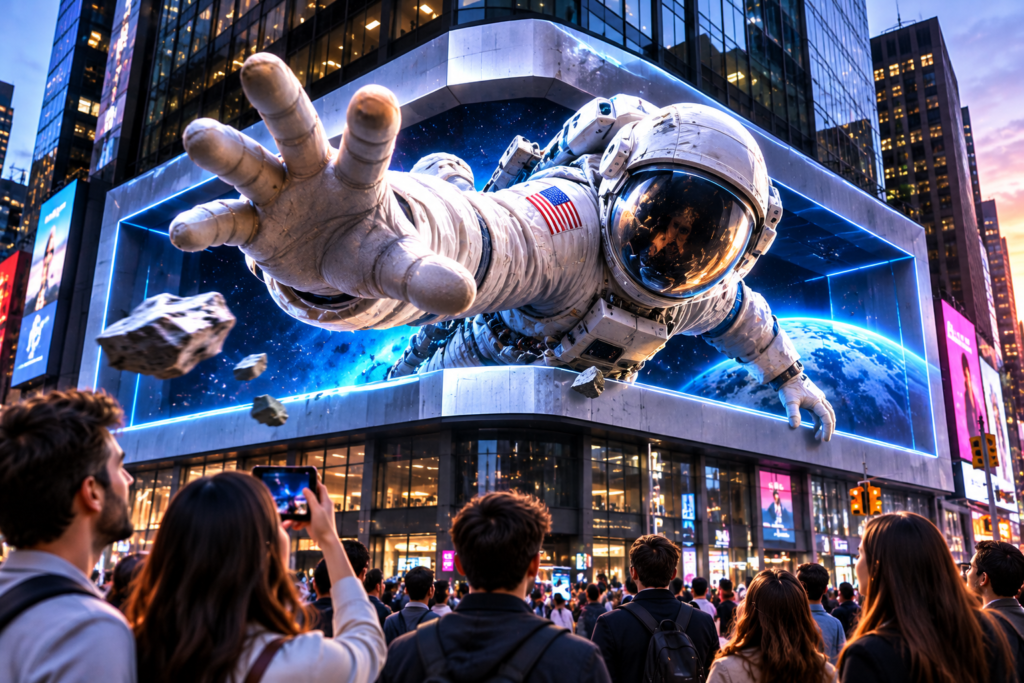
Imagine walking through a busy American city when an enormous sneaker suddenly appears to break through a building. A few streets away, a luxury watch seems to float beyond the boundaries of a digital screen, with reflections that make its metallic surface look almost tangible. Although these objects never physically occupied the streets, the visual illusions could easily have persuaded passing audiences to look twice.
However, creating these illusions involved more than producing an attractive 3D animation. The success of a campaign depended on the relationship between visual style, viewing perspective, screen architecture, and audience expectations. Photorealistic and stylized animation offered different creative possibilities, and understanding those differences helped advertisers make more informed production decisions.
What Is the Difference Between Photorealistic and Stylized 3D Animation?
Photorealistic and stylized 3D animation represented two approaches to visual storytelling, and each offered particular advantages for anamorphic advertising.
Photorealistic animation attempted to recreate the appearance of physical objects through accurate modeling, believable materials, realistic lighting, and carefully calculated shadows. When these techniques were combined with anamorphic perspective, digital objects could appear to occupy space beyond the boundaries of a screen.
Stylized animation followed a different creative philosophy because it allowed designers to exaggerate shapes, introduce imaginative colors, and develop movements that would not have been possible in reality.
The distinction was therefore not simply about visual quality. Photorealism supported physical believability, whereas stylization offered greater freedom to express personality and imagination.
When Should USA Brands Choose Photorealistic 3D Animation
Photorealistic animation was particularly suitable for campaigns in which the appearance and construction of a product influenced how audiences perceived its value.
Consider a premium watch advertisement displayed on a large urban LED screen. The watch could have appeared to rotate beyond the display, revealing its polished case, textured dial, and intricate mechanical details. Realistic lighting and reflections would have strengthened the impression that the product occupied the surrounding physical environment.
Photorealistic 3D Animated Product Videos for USA Brands
Photorealistic 3D animated product videos offered American businesses an alternative way to present products that were difficult to transport, photograph, or demonstrate through conventional filming.
An industrial equipment manufacturer, for instance, could have displayed an enormous machine on a digital billboard and used animation to reveal its internal components. A consumer electronics company might have introduced a device through a detailed sequence showing its construction and important features.
Nevertheless, technical accuracy remained important. A dramatic visual presentation could have exaggerated a product’s size for creative purposes, but it should not have suggested capabilities or specifications that the product did not possess.
Stylized 3D Animation: Where Simplified Visuals Build Brand Recognition
Although photorealistic animation offered convincing illusions, stylized animation created opportunities for brands to develop more imaginative and recognizable visual identities.
Rather than reproducing the physical world, designers could have constructed unusual environments, expressive characters, and exaggerated movements around a brand’s established personality.
A beverage company might have transformed its packaging into a playful animated character that interacted with the edges of a digital screen. An entertainment brand could have introduced a fictional creature that appeared to escape from an imaginary world inside the billboard.
Stylized animation also offered advantages when advertisers needed to communicate abstract ideas. Technology companies, for example, could have represented digital processes through simplified objects and visual metaphors rather than attempting to reproduce complicated technical systems.
However, creative freedom still required discipline. An outdoor advertisement filled with unrelated movements and visual effects could have distracted viewers from the product or message being promoted.
Photorealistic vs. Stylized 3D Animation Cost and Production Time
The production cost of an anamorphic billboard campaign depended on several factors, including animation complexity, modeling requirements, rendering demands, and the specifications of the intended display.
Photorealistic projects often required detailed product models, carefully developed materials, realistic reflections, and sophisticated lighting. These elements could have increased the time needed for asset preparation and rendering.
Stylized projects sometimes required less attention to realistic textures, although custom character design, elaborate environments, and expressive animation could have demanded considerable production effort.
| Production factor | Photorealistic animation | Stylized animation |
| Modeling requirements | Detailed geometry based on realistic references | Simplified or exaggerated forms developed around an artistic direction |
| Material development | Realistic textures, reflections, and surface finishes | Artistic colors, textures, and materials |
| Lighting | Physically believable illumination and shadows | Flexible lighting designed around the visual concept |
| Animation | Movement guided by realistic physical behavior | Movement that could be exaggerated for expression |
| Rendering | Potentially demanding because of realistic visual effects | Dependent on the complexity of the chosen style |
| Creative preparation | Greater emphasis on product and environmental accuracy | Greater emphasis on original visual development |
How a 3D Animation Video Company Prices Realistic vs. Stylized Work
A professional 3D animation video company would generally have evaluated the entire production scope before preparing a quotation.
Businesses researching top 3D animation services USA would have benefited from examining the services included in each proposal rather than comparing prices without considering production requirements.
A comprehensive quotation should have explained the costs associated with concept development, modeling, animation, perspective mapping, revisions, rendering, and final display preparation.
How Does Your Target Audience Affect the Choice of 3D Animation Style
A luxury-focused campaign might have benefited from refined lighting, elegant movement, and realistic product materials because these elements could have reinforced perceptions of craftsmanship.
An entertainment campaign targeting younger audiences, however, might have achieved stronger recognition through imaginative characters and exaggerated visual effects.
The physical location of the billboard also influenced audience behavior. People passing through a busy intersection might have encountered only a few seconds of an advertisement, whereas pedestrians near a public plaza could have had more time to observe an extended animation.
Viewing perspective introduced another challenge. An anamorphic illusion designed for a particular position could have appeared distorted when viewed from a different angle.
For this reason, effective creative planning required advertisers to consider both the characteristics of their target audience and the conditions under which the campaign would have been viewed.
Best 3D Animation Style for Product Demos, Explainers, and Ads
The appropriate animation style depended on what the advertisement needed to communicate.
Product demonstrations generally benefited from realistic rendering when audiences needed to recognize physical features, examine materials, or understand mechanical functions.
Explainer campaigns often benefited from stylized animation because abstract information could have been represented through simplified visual sequences.
Brand-awareness advertisements offered greater flexibility. A premium product launch might have emphasized realistic materials and dramatic lighting, while a gaming campaign could have relied on imaginative environments and expressive characters.
Anamorphic advertising added another consideration because the main message needed to remain understandable even when viewers encountered only part of the animation.
Which Style Works Better for 3D Animated Product Videos in the USA
Neither animation style offered a universal advantage for product marketing.
A realistic animation could have been more appropriate for an industrial machine whose dimensions and components influenced purchasing decisions. A stylized animation might have been more effective for a consumer product whose appeal depended on personality or an emotional experience.
Businesses considering a custom animation service would have benefited from defining whether their campaigns needed to emphasize physical accuracy, emotional appeal, or a combination of both.
The creative approach would then have followed the communication objective rather than a preference for visual complexity.
Can You Combine Photorealistic and Stylized 3D Animation in One Video
Hybrid animation offered advertisers opportunities to combine realistic product presentations with imaginative visual storytelling.
An electric vehicle could have appeared to emerge from a digital billboard with realistic reflections and accurate proportions. As the vehicle rotated, stylized energy pathways might have appeared around it to communicate a concept that could not have been represented through ordinary product photography.
These combinations allowed advertisers to preserve product recognition while introducing visual elements that supported explanation or entertainment.
However, the different styles needed to be coordinated carefully. Lighting, color, camera movement, and transitions had to follow a consistent visual direction so that the finished animation would not have appeared fragmented.
How to Choose a 3D Animation Style Before Briefing a Studio
The development of an anamorphic campaign should have begun with an understanding of the physical advertising environment.
Before commissioning animation, brands needed to confirm the screen’s dimensions, resolution, architectural structure, viewing angles, and playback requirements.
A corner LED display offered different opportunities for perspective manipulation from those available on a flat digital screen. Consequently, an animation developed without accurate screen specifications could have required substantial revisions. The creative brief also needed to establish the campaign’s primary objective.
A product launch might have focused on recognition and product features, whereas an entertainment campaign could have prioritized a surprising visual experience.
How to Judge a 3D Animation Studio’s Portfolio for Style Fit
An impressive portfolio did not necessarily demonstrate expertise in anamorphic billboard production.
Businesses searching for the best 3D animation firm needed to examine whether prospective studios understood perspective mapping, large-format displays, and the relationship between digital content and physical architecture.
Relevant portfolio examples would ideally have demonstrated convincing depth, accurate perspective, controlled lighting, and thoughtful integration with the surrounding environment.
Brands also benefited from distinguishing between conceptual demonstrations and projects that had been successfully displayed in public locations.
Frequently Asked Questions
What made anamorphic 3D billboards different from traditional digital billboards?
Traditional billboards displayed flat graphics and videos, while anamorphic billboards used perspective distortion to create realistic 3D illusions.
Did anamorphic digital billboards require specialized LED screens?
No. They could use flat or corner LED screens, depending on the desired effect, screen dimensions, and viewing angle.
How long could an anamorphic billboard animation project take?
Timelines depended on concept complexity, available 3D assets, screen specifications, and the number of revisions.
Could anamorphic billboard content be reused for social media advertising?
Yes. Brands could reuse 3D models and animation assets, but footage often needed adjustments for different screen formats and viewing angles.
How could USA brands measure the effectiveness of anamorphic billboard campaigns?
Brands could track audience exposure, branded searches, website visits, social engagement, and brand recall, although these metrics might not directly prove sales impact.
Conclusion
Anamorphic digital billboards introduced new creative possibilities for brands that wanted their outdoor advertising to feel more engaging and memorable. Photorealistic animation helped establish believable product illusions, while stylized animation offered opportunities to create expressive characters, imaginative environments, and distinctive brand experiences.
For American businesses considering this approach, Split Arts Technologies offered 3D animation and creative production capabilities that could support the development of visually engaging campaign concepts. A carefully planned creative direction, supported by realistic technical expectations, would have provided the strongest foundation for an anamorphic advertising experience that audiences could understand and remember.