Animation has always been a craft driven by human imagination. From the earliest hand-drawn frames to today’s digital production pipelines, the skill, perspective, and vision of the animator have remained at the center of the process.
intelligence is now entering that process with tools that speed up production, reduce repetitive tasks, and expand creative possibilities.
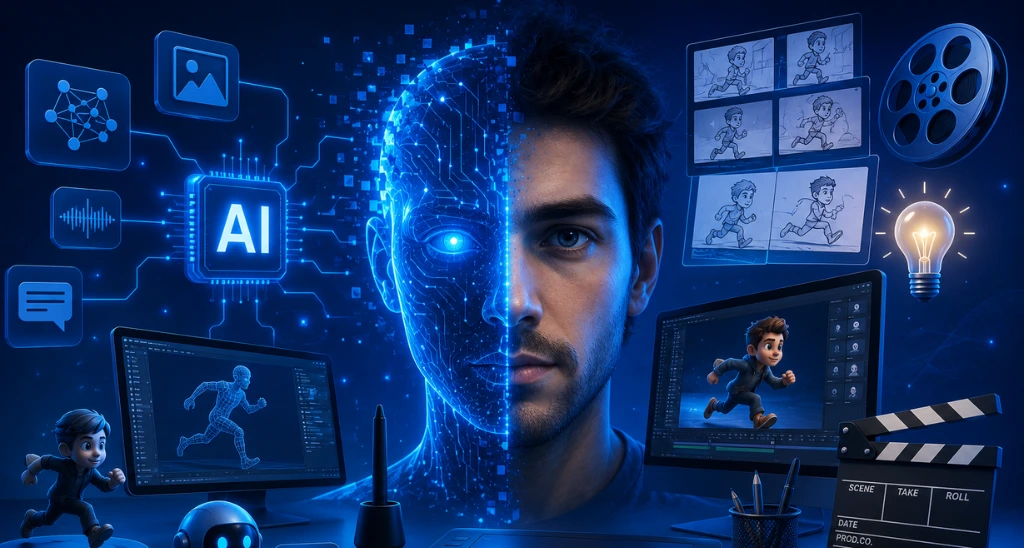
The conversation around AI and animation is often framed as a competition. In practice, it is more accurate to describe it as a collaboration. Animation services USA company teams that combine AI efficiency with human creative direction are producing work at a pace and quality level that neither could achieve working alone.
This shift is not a threat to the craft of animation. It is an evolution of how that craft gets executed.
The Importance of Human Creativity in Animation
Creativity in animation is not just about producing visually attractive motion. It involves understanding what an audience needs to feel, what a brand needs to communicate, and how story structure shapes the viewer’s emotional journey through a piece.
Human animators bring cultural context, emotional intelligence, and lived experience to every project. These are qualities that no algorithm can replicate. A character that resonates with an audience, a visual metaphor that lands perfectly, or a color palette that captures a brand’s tone accurately all come from decisions that require genuine creative judgment.
What Human Animators Bring to Every Project
- Emotional storytelling that creates a real connection with audiences
- Brand interpretation that goes beyond surface-level visual matching
- Cultural nuance and sensitivity that prevent misaligned messaging
- Artistic intuition developed through years of practice and observation
- The ability to solve creative problems that have no established formula
- Original character and world design that feels genuinely distinctive
These qualities are not replaceable by tools that operate on pattern recognition and data optimization. They are what make animation memorable rather than merely functional.
How AI Speeds Up Animation Production
AI is changing the animation production process in ways that benefit studios, clients, and creative teams. The most immediate impact is on speed. Tasks that once required hours of repetitive manual work can now be completed in a fraction of the time.
In-betweening is the process of generating frames between two keyframes to create smooth motion. It has traditionally been one of the most time-consuming parts of animation. AI can now handle this automatically with a high degree of accuracy, freeing animators to focus more time on character design, storytelling, and overall visual direction.
Areas Where AI Is Transforming Animation Workflows
- Automated in-betweening that speeds up frame generation significantly
- AI-assisted lip-sync that matches the character’s mouth movements to the audio
- Background generation from text prompts that reduces environment creation time
- Style transfer tools that apply consistent visual language across an entire project
- Motion capture data cleanup that removes noise and improves fluidity
- Asset tagging and library management that make production pipelines faster
Professional 2D animation services and 3D production houses are adopting these tools to reduce turnaround times without compromising on quality. The efficiency gains allow creative teams to take on more ambitious projects within the same timelines as before.
Benefits of AI-Assisted Animation Services
The benefits of AI-assisted animation services extend beyond faster production. They create space for greater creative ambition by removing the bottlenecks that used to make complex animation projects prohibitively expensive or time-intensive.
Clients benefit directly from shorter delivery timelines and lower revision costs. When AI handles repetitive production tasks, the studio’s time is focused on the creative decisions that genuinely matter. This results in a more collaborative process where feedback cycles are faster and the final output reflects client input more accurately.
How AI Assistance Improves Client Outcomes
- Faster turnaround means campaigns can launch on schedule
- Reduced production costs make professional animation accessible to more brands
- More revision cycles become possible within the same budget window
- Consistent quality is maintained across large animation libraries
- More content variations can be produced for A/B testing campaigns
- Scalable production adjusts to project size without losing overall quality
A top explainer video service that integrates AI into its workflow is better positioned to deliver both creative and commercial value to clients. The technology amplifies the team’s output without replacing the creative intelligence behind it.
Human Creativity vs Artificial Intelligence in Animation
The debate around human creativity versus artificial intelligence often focuses on what AI can produce rather than what it lacks. AI tools can generate visuals, suggest color combinations, and animate basic sequences. What they cannot do is understand why a particular visual choice will resonate with a specific audience in a specific cultural context.
Creativity is not purely about output. It involves intention, meaning, and the ability to make choices that serve a larger purpose. These are human capabilities, and they remain central to what makes animation effective as a communication tool.
Where the Real Differences Lie
- AI optimizes based on existing patterns. Human creators can break patterns intentionally.
- AI generates content at scale. Human judgment decides which content is worth scaling.
- AI accelerates execution. Human vision defines what is worth executing in the first place.
- AI applies rules consistently. Human creativity knows that breaking those rules produces better results.
The most effective animation studios are not choosing between AI and human creativity. They are building workflows where each does what it is best suited to do, and that combination is producing the strongest work in the industry.
Future of 2D and 3D Animation
The future of 2D and 3D animation is being shaped by the convergence of AI tools, real-time rendering technology, and an expanding demand for animated content across every digital platform. Both formats are evolving rapidly and continue to find strong demand across different industries and use cases.
2D animation is gaining renewed interest through its association with brand personality and hand-crafted aesthetics. Many brands are returning to flat, illustrative styles because they feel warmer and more human in a digital environment dominated by high-polish 3D visuals.
Trends Shaping the Future of Animation
- Real-time rendering makes 3D production faster and more cost-efficient
- AI-generated asset creation reduces environment and background production time
- Increased demand for short-form animated content across social platforms
- Growth in interactive animation for apps, games, and web experiences
- Expansion of animated content into augmented reality and immersive environments
- Greater personalization of animated content at scale for marketing campaigns
A 3D animation company in the USA that stays current with these trends is better equipped to offer clients content that performs well now and holds up as platforms and audience expectations continue to evolve.
Why Creativity Still Matters in the AI Era
There is a risk that studios and brands over-correct in response to AI capabilities and begin treating animation as a production problem rather than a creative one. When the emphasis shifts entirely to speed and volume, the creative quality that makes animation effective tends to suffer.
Audiences are sophisticated. They respond to content that feels intentional, emotionally resonant, and distinctive. These qualities require creative investment. A brand that produces high volumes of AI-generated animation without strong creative direction ends up with content that looks busy but communicates very little.
What Keeps Creativity Central in Modern Animation
- Original concept development that starts with a genuine insight into the audience
- Thoughtful art direction that reflects the brand’s unique personality
- Storytelling structures that guide viewers through a clear emotional arc
- Design choices that feel distinctive rather than templated or generic
- A commitment to quality that prioritizes meaningful impact over raw volume
Common Mistakes in AI-Assisted Animation
The increasing availability of AI animation tools has led some brands to treat animation as something they can produce entirely in-house without creative expertise. This approach often leads to outputs that look unpolished and fail to reflect the brand accurately.
Another common mistake is using AI-generated visuals without proper creative oversight. AI tools produce outputs based on prompts, but they cannot evaluate whether those outputs are strategically appropriate or visually aligned with a brand’s identity.
Things to Avoid When Using AI in Animation
- Using AI tools to replace strategic creative direction entirely
- Skipping the scripting and storyboarding stage because AI can generate visuals quickly
- Applying AI-generated styles that conflict with existing brand guidelines
- Treating AI output as final without human review and refinement
- Over-relying on AI for character design, which requires genuine creative originality
- Producing large volumes of content without quality control at each stage
Brands that use AI as a support tool within a human-led creative process consistently produce better animation than those treating AI as a shortcut to bypass professional expertise.
Frequently Asked Questions
1. Can AI fully replace human animators in the future?
No, AI can automate tasks, but human creativity, storytelling, and artistic direction remain essential.
2. How does AI actually help animators work faster?
AI speeds up repetitive tasks like lip-syncing, in-betweening, and asset organization, giving animators more time for creative work.
3. Is AI-generated animation good enough for professional brand use?
AI visuals can help with concepts and drafts, but human refinement is usually needed to meet professional brand standards.
4. What is the future of 2D animation given the rise of AI?
2D animation remains popular because of its unique visual style. AI is helping make production faster and more accessible.
5. How should brands think about AI and animation together?
Brands should use AI as a support tool to improve efficiency while keeping human creativity and strategy at the core.
Final Thoughts
The future of animation belongs to studios and brands that understand how to combine AI efficiency with human creative excellence. Neither element alone produces the best results. Together, they create work that is faster, more ambitious, and more precisely executed than traditional workflows allowed.
Split Arts brings together creative expertise and modern production tools to deliver animation that performs across every format and platform. Whether you need professional 2D animation services, a 3D campaign, or a full explainer video strategy, the team is ready to build content that genuinely moves audiences.
Get in touch to start a conversation about your next animation project.