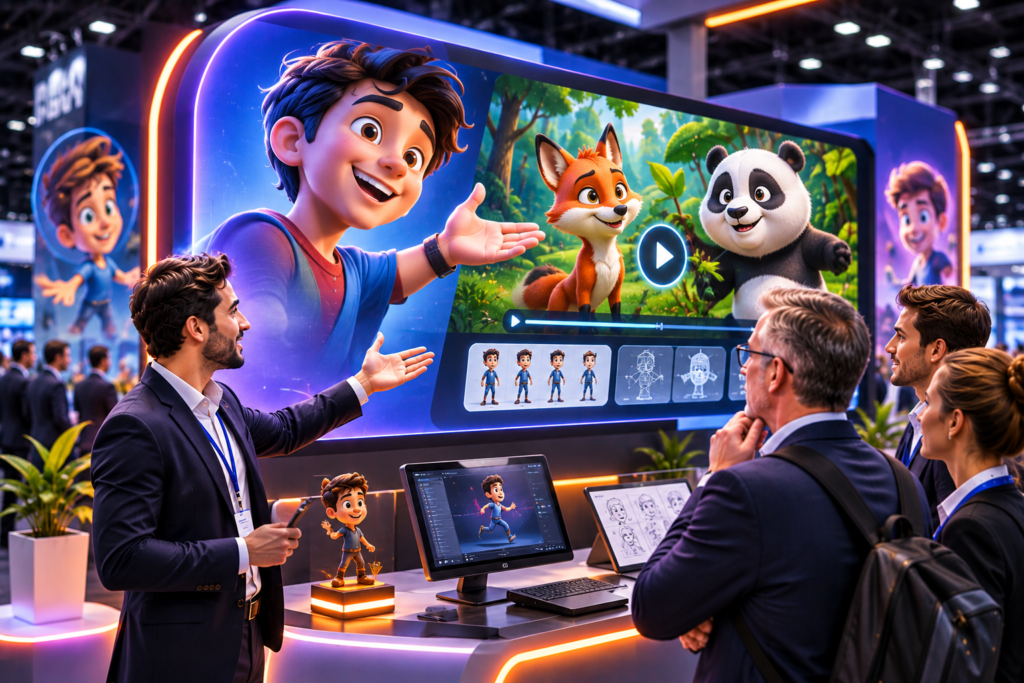
A booth may have cost months of planning, yet its most important conversation can begin in the three seconds before a passerby decides to stop. The screen at the back of the stand is therefore not decoration; it is a visual salesperson.
Well-designed 3D animation can make a hidden mechanism understandable, give a new product physical presence, and provide a memorable opening for an actual discussion. Poorly designed motion merely adds noise to an already noisy hall.
Why Does 3D Animation Grab Attention on a Crowded Trade Show Floor
A trade show visitor may have only a few seconds to decide where to stop. A moving cutaway, an exploded assembly, or a dramatic shift in scale communicates more quickly than a dense wall of product specifications.
Motion should answer a business question like, what does this machine do, and why should I care?
At an industrial exhibition, a motor could be shown opening into its component layers before reassembling around a highlighted efficiency feature. That visual would make a technical claim easier to discuss, provided the underlying performance claim had been verified.
A practical decision before production
For this part of the project, write down the single question the intended viewer needs answered. Then compare the proposed visual against the information the team can actually verify. A persuasive result will be specific enough to be useful but restrained enough not to promise capabilities that have not been demonstrated. The creative director, subject specialist, and person responsible for final approval should agree on that boundary before the work moves into expensive production.
3D Trade Show Booth Animation: Best Display Formats for LED Walls, Kiosks, and Video Towers
A wide LED wall is useful for one large visual idea, whereas a kiosk works better for deliberate exploration. Tall video towers favor portrait framing and readable, oversized elements. The same animation rarely fits all three without a re-edit. Ask the exhibit contractor for pixel dimensions, physical viewing distance, refresh rate, and the playback system. A 4K file alone does not guarantee a sharp display if the wall has an unusual aspect ratio or the media server scales it poorly.
The detail that often gets overlooked is the handoff between the creative team and the people who will use the finished asset. A sales representative, campaign manager, engineer, editor, or web developer may notice problems that are invisible in a presentation mockup.
Invite that person into review early, ask them to test the work in context, and document the decision. That extra conversation is usually more valuable than polishing an effect that never helps the audience.
3D Product Animation for Trade Shows: Showcasing Products Too Large, Complex, or Unfinished to Display
Some products cannot be transported economically; others are sealed, hazardous, microscopic, or still in development. A 3D video animation services can expose hidden components and demonstrate an intended workflow without shipping a full-scale prototype.
Accuracy matters more than spectacle when buyers are evaluating engineering claims. Mark conceptual features as concepts, verify dimensions against drawings, and avoid showing functionality that the finished product will not deliver.
A practical decision before production
For this part of the project, write down the single question the intended viewer needs answered. Then compare the proposed visual against the information the team can actually verify.
A persuasive result will be specific enough to be useful but restrained enough not to promise capabilities that have not been demonstrated. The creative director, subject specialist, and person responsible for final approval should agree on that boundary before the work moves into expensive production.
Looping 3D Animation vs. Interactive 3D Exhibit Experiences: What Works Best for Your Booth
A loop attracts people who are passing by. An interactive viewer rewards someone who has already stopped and wants to examine variants, features, or internal systems. They serve different moments in the same visitor journey. For a small booth, a polished 20-second loop paired with a salesperson-led tablet demo may be more practical than an elaborate touchscreen wall. Interactivity adds device testing, interface design, and on-site support requirements.
The detail that often gets overlooked is the handoff between the creative team and the people who will use the finished asset. A sales representative, campaign manager, engineer, editor, or web developer may notice problems that are invisible in a presentation mockup. Invite that person into review early, ask them to test the work in context, and document the decision. That extra conversation is usually more valuable than polishing an effect that never helps the audience.
How Long Should a Trade Show Booth Animation Be? Ideal Video Length for Walk-By Visitors
There is no universal ideal duration. The opening three to five seconds should establish the product or benefit, while a short self-contained sequence may run around 15 to 30 seconds before repeating.
Longer demonstrations belong on a kiosk or in a sales conversation. Design the loop so that a visitor arriving halfway through can still understand it. Avoid an extended logo intro, and test the edit while walking past a monitor at realistic speed.
A practical decision before production
For this part of the project, write down the single question the intended viewer needs answered. Then compare the proposed visual against the information the team can actually verify.
A persuasive result will be specific enough to be useful but restrained enough not to promise capabilities that have not been demonstrated. The creative director, subject specialist, and person responsible for final approval should agree on that boundary before the work moves into expensive production.
How to Design Silent-Friendly 3D Booth Animation for Noisy Convention Centers
A convention hall is a poor place to rely on narration. Strong silhouettes, concise on-screen labels, visual contrast, and recognizable cause-and-effect sequences make a silent animation easier to understand. Captions should be tested at actual display size. Tiny annotations may look excellent on a designer’s monitor and become illegible across an aisle. Build an audio-enhanced version separately if the booth will also use headphones.
The detail that often gets overlooked is the handoff between the creative team and the people who will use the finished asset. A sales representative, campaign manager, engineer, editor, or web developer may notice problems that are invisible in a presentation mockup. Invite that person into review early, ask them to test the work in context, and document the decision. That extra conversation is usually more valuable than polishing an effect that never helps the audience.
How Does 3D Animation Help Your Exhibit Stand Out From Competitors at USA Trade Shows
The goal is not merely to be louder than neighboring displays. A useful animation makes the difference between competing products visible: fewer steps, easier access for maintenance, or a clearer view of a proprietary mechanism. Decide on one takeaway before storyboarding. If viewers remember only a spinning logo, the animation has occupied space without supporting the sales pitch. Pair the visual with a direct question that staff can use to start a conversation.
A practical decision before production
For this part of the project, write down the single question the intended viewer needs answered. Then compare the proposed visual against the information the team can actually verify.
A persuasive result will be specific enough to be useful but restrained enough not to promise capabilities that have not been demonstrated. The creative director, subject specialist, and person responsible for final approval should agree on that boundary before the work moves into expensive production.
What You Need Before Ordering a 3D Trade Show Animation: Screen Specs, File Formats, and Show Deadlines
Provide the booth plan, screen map, technical drawings, brand guidelines, approved claims, and a realistic production schedule. Confirm codec, resolution, orientation, frame rate, looping behavior, and whether playback requires a special media server. Allow time for a technical test on the actual hardware, not just approval by email. A final file delivered the night before the show leaves little room for fixing color, cropping, or compatibility issues.
The detail that often gets overlooked is the handoff between the creative team and the people who will use the finished asset. A sales representative, campaign manager, engineer, editor, or web developer may notice problems that are invisible in a presentation mockup.
Invite that person into review early, ask them to test the work in context, and document the decision. That extra conversation is usually more valuable than polishing an effect that never helps the audience.
A Real-World Production Checklist
Before the project is approved, confirm the intended audience for 3D animation services USA, the channel, the one message that matters most, and the evidence supporting any technical or commercial claims. Identify the person who approves the script and the person who approves the final file.
Record required dimensions, languages, accessibility needs, source materials, and usage rights. Keep one version-controlled feedback document so contradictory comments do not reach the production team. Finally, test the deliverable where it will actually be used. A beautiful preview is not a substitute for a working file.
FAQs
How does 3D animation help a trade show booth attract more visitors?
3D animation uses movement, product demonstrations, and visual storytelling to capture attention in busy exhibition halls. It can show how a product works, highlight important features, and give visitors a reason to stop and speak with the sales team.
What is the ideal length for a 3D trade show booth animation?
A short loop of around 15 to 30 seconds can work well for visitors passing a booth. The opening seconds should communicate the main message quickly, while longer demonstrations can be reserved for kiosks or guided sales presentations.
Should I choose a looping animation or an interactive 3D exhibit?
A looping animation works well for attracting attention from a distance, while an interactive exhibit allows interested visitors to examine specific features, components, or product variations. The right choice depends on your booth layout, audience, budget, and available on-site support.
What technical requirements should I confirm before ordering a 3D trade show animation?
Confirm the screen dimensions, resolution, aspect ratio, frame rate, file format, playback system, and looping requirements with your exhibit contractor. Testing the final animation on the actual display before the event can help identify compatibility and visibility issues.
Can 3D animation showcase products that cannot be displayed at a trade show?
Yes. 3D animation can demonstrate oversized machinery, sealed equipment, internal components, hazardous systems, and products still in development. The visuals should accurately reflect verified specifications and clearly distinguish conceptual features from confirmed product capabilities.
Conclusion
The most effective work starts with a precise communication problem, not a fashionable visual effect. Careful planning, realistic production expectations, and testing in the final environment will matter as much as the animation itself.
For businesses weighing their next creative project, Split Arts Technologies the 3D animation agency USA offers animation and related digital production services; a useful first conversation would focus on the audience, deliverables, and evidence needed to make the idea work.