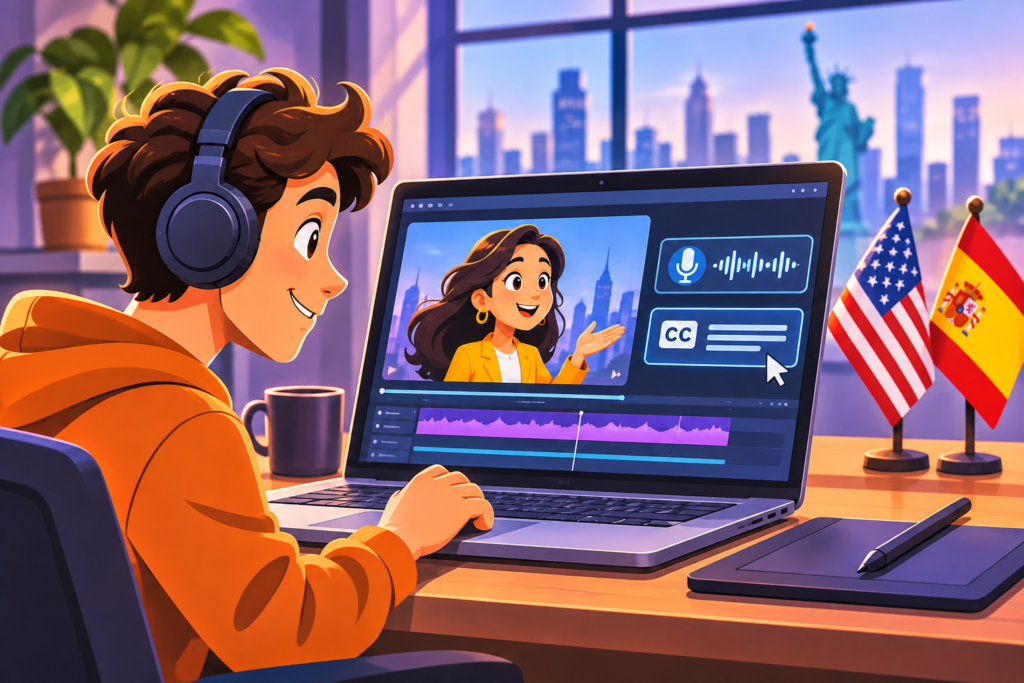
If watching an animated advertisement makes you smile, the characters sound natural, the story flows smoothly, and the message stays with you. Now imagine watching the same video in Spanish, except the characters speak too quickly, the jokes sound strange, and some words remain in English.
Although the visuals have not changed, the experience feels completely different.
That is why localizing a 2D animated video involves more than translating the script. The voiceover, humor, on-screen text, cultural references, and animation timing must all feel natural to Spanish-speaking audiences in the United States. When these details come together, the localized version can deliver the same message and emotional impact as the original.
What Is 2D Animation Localization for Spanish-Speaking US Audiences
2D animation localization means adapting an animated video for people who speak another language. It includes translating dialogue, adjusting cultural references, recording new voices, and updating text that appears on screen.
The goal is to make the message easy to understand while keeping the original story and personality intact.
Why Spanish Localization Requires More Than Translation
Spanish-speaking communities across the United States have different backgrounds and language preferences. A phrase that sounds familiar to someone from Mexico may not be commonly used by someone from Puerto Rico or Colombia.
For example, an animated healthcare video designed for Spanish-speaking families in Texas may need a different tone from a national advertisement targeting bilingual young adults.
Brands planning multilingual campaigns can benefit from discussing localization when arranging 2D animation services, rather than waiting until the English video has already been completed.
Spanish Voiceover for 2D Animation: Neutral vs. US Hispanic Accents
A character’s voice can change how an audience feels about the entire video. A friendly character needs to sound welcoming, while an educational narrator should communicate information clearly and confidently.
Choosing the right Spanish voiceover therefore involves more than finding someone who speaks Spanish fluently.
When Neutral Spanish Works Best
Neutral Latin American Spanish generally avoids strongly regional expressions. It can be useful for advertisements, educational videos, and product explainers intended for Spanish-speaking audiences from different backgrounds.
However, neutral Spanish should still sound conversational. A voice actor who reads every sentence too formally may make an otherwise friendly animation feel unnatural.
When a US Hispanic Voice Feels More Familiar
A US Hispanic voice may suit a campaign aimed at a particular community or demographic. Depending on the audience, certain expressions or pronunciation patterns may sound more familiar.
The best approach is to listen to voice auditions using the actual script. This helps the production team understand whether the voice matches the character, audience, and message.
Translation vs. Transcreation for Spanish 2D Animated Scripts
Translation focuses on communicating the meaning of words in another language. Transcreation goes further by adapting expressions, humor, and emotional messages so they feel natural to the intended audience. Both approaches have a place in animation, but they serve different purposes.
Why Word-for-Word Translation Can Sound Awkward
Consider an English advertisement that describes a simple process as “a piece of cake.”
Translating that expression word for word may not communicate the intended meaning naturally. A Spanish writer could instead use a familiar expression that tells viewers the process is easy. The wording changes, but the message remains the same.
Keeping the Original Story’s Personality
Transcreation should preserve the character’s personality and the purpose of the video. A playful animated character should still sound playful in Spanish. Similarly, a serious educational video should not become overly casual simply because certain expressions are more familiar.
The important consideration is whether the audience understands the message in the way the brand intended.
Spanish Subtitles vs. Dubbing for 2D Animated Videos
Subtitles and dubbing are two common ways to make English animated videos accessible to Spanish-speaking audiences.
Subtitles display translated text while the original audio continues playing. Dubbing replaces the original speech with Spanish dialogue.
When Spanish Subtitles Are a Better Choice
Subtitles can work well for short social media advertisements, interviews, and informational videos.
They are especially useful when viewers watch content without sound. However, subtitles should remain visible long enough to be read comfortably.
If an animated scene contains several moving elements, lengthy subtitles may distract viewers from important visuals.
When Spanish Dubbing Creates a Better Experience
Dubbing often works better for character-driven animations, children’s content, and detailed explainers.
Viewers can concentrate on the animation instead of reading dialogue at the bottom of the screen.
For some projects, combining Spanish dubbing with optional captions offers greater flexibility and accessibility.
How to Localize On-Screen Text in 2D Animation
Animated videos often include written information beyond spoken dialogue. Headlines, labels, buttons, charts, and calls to action may all need translation.
Leaving these elements in English can make the Spanish version feel incomplete.
Translating Graphics Without Affecting the Design
Imagine a character pointing toward a button labeled “Get Started.” If the narration is in Spanish but the button remains in English, viewers may experience an unnecessary interruption.
Designers should identify every piece of visible text before localization begins.
Keeping text layers editable makes it easier to replace words without rebuilding entire scenes.
Choosing Readable Fonts and Text Placement
Spanish includes accented characters and punctuation that must display correctly.
Some translated phrases also take up more space than their English equivalents. Designers may need to adjust line breaks, text boxes, or font sizes.
The goal is to keep every message readable without overcrowding the animation.
Cultural Adaptation in 2D Animation for Hispanic Audiences
Language is only one part of communication. Characters, situations, humor, and everyday references also influence whether an animated story feels relatable.
However, cultural adaptation should never depend on stereotypes.
Creating Characters and Situations That Feel Real
Consider an animation about a family managing household expenses. The characters do not need exaggerated cultural symbols to connect with Hispanic viewers.
Natural conversations, familiar situations, and respectful character development can create a stronger connection.
The setting should also reflect the campaign’s purpose. A video intended for Spanish-speaking Americans may need to reference services, institutions, or everyday experiences specific to life in the United States.
Why Cultural Review Matters
A phrase may be grammatically correct but sound unusual to the intended audience.
Native-speaking reviewers familiar with the target community can identify these problems before the video is released.
Their feedback can improve dialogue, humor, and cultural references without changing the central message.
How Does Spanish Text Expansion Affect Animation Timing
Animation depends on carefully planned timing. Character movements, scene transitions, narration, and music are often designed to work together.
When dialogue is translated into Spanish, some sentences may become longer or require additional speaking time.
Why Longer Dialogue Can Affect Animation
Suppose an English narrator explains a product feature in four seconds. The Spanish translation may require five seconds to sound natural.
If the animation continues at its original speed, the narrator may be forced to speak too quickly.
This can make important information difficult to understand.
Adjusting Scenes for Natural Spanish Dialogue
Animation teams can extend selected scenes, adjust character movements, or simplify translated sentences without changing their meaning.
When characters visibly speak, their mouth movements may also need to match the new dialogue.
Businesses considering professional 2D animation services USA for multilingual projects should discuss these requirements before production, particularly when several language versions are planned.
How Much Does Spanish 2D Animation Localization Cost
The cost of localization depends on how much work the original animation requires.
A short video with simple narration and limited on-screen text may be relatively straightforward to adapt. A detailed animation featuring several characters, extensive dialogue, and synchronized mouth movements usually involves more production work.
Factors That Influence Localization Pricing
Script translation, transcreation, voice casting, recording, subtitles, and graphic adjustments can all affect the final estimate.
The availability of original project files also matters. Editable animation files generally make changes easier than videos that exist only as finished exports.
Additional language reviews or revisions may increase the overall cost.
How to Plan a Practical Localization Budget
Before requesting an estimate, businesses should identify the video’s length, intended audience, required Spanish voiceover, and preferred delivery formats.
It is also useful to confirm whether the production team will provide subtitle files and editable localized materials.
Clear expectations help prevent unexpected costs and make future updates easier.
Frequently Asked Questions
1. Can one Spanish animated video work for all Hispanic audiences in the United States?
A broadly understandable Spanish version can reach many audiences. However, vocabulary, accents, and cultural references should still reflect the people the campaign intends to reach.
2. Is Spanish dubbing better than subtitles for animated videos?
Neither option is always better. Dubbing can provide a more natural experience for character-driven stories, while subtitles may be more practical for short social media content or viewers who prefer reading.
3. Does localization require creating the entire animation again?
Usually not. Existing visuals can often be reused, although dialogue timing, mouth movements, and on-screen text may need adjustments.
4. How long does Spanish 2D animation localization take?
The timeline depends on video length, translation complexity, voiceover requirements, and the amount of animation editing needed. Projects with several speaking characters generally require more coordination.
5. When should a business start planning Spanish localization?
Ideally, localization should be considered during scriptwriting and storyboarding. Early planning makes it easier to accommodate translated dialogue, editable graphics, and different language versions.
We Are Here to Make Every Language Feel Like the Original Story
A well-localized animated video should never feel like an English advertisement with Spanish words added afterward. Its dialogue should sound natural, its characters should remain believable, and its visuals should support the message without creating confusion.
Successful localization depends on thoughtful writing, appropriate voice casting, cultural understanding, and careful animation adjustments. When these elements work together, the Spanish version can communicate the same ideas while feeling genuinely relevant to its audience.
For brands planning multilingual animated content, Split Arts Technologies offers animation production capabilities that can support the development of clear and engaging visual stories. By considering localization early, businesses can create videos that communicate more effectively with Spanish-speaking audiences throughout the United States.