Remember any last thing recently that you have bought online?
Where you were 98% sold. The reviews checked out. The price felt fair. Your cursor drifted toward the button but while checking out something stopped you.
The product looked right, but you couldn’t quite verify it. So you did what everyone does: told yourself you’d come back later.
You didn’t come back later. Nobody does.
That tiny moment, the almost, is the most expensive moment in ecommerce. It happens millions of times a day, on product pages from Miami to Seattle, and it has nothing to do with price or shipping or competition. It’s a confidence shortage. The buyer wanted one more reason to be sure, and the page didn’t give it to them.
More and more USA businesses have figured out how to close that gap, and they’re doing it with the same tool: 3D product animation. Not as decoration. As a trust-building machine.
Why Buyer Confidence Matters Before Every Purchase
Here’s a truth every sales floor veteran knows and every ecommerce store has to relearn: people don’t buy products. They buy certainty. The feeling that what they think they’re getting is what will actually show up at the door.
In a physical store, certainty is free. You pick the thing up. You test the hinge, feel the fabric, check the weight. Online, all of that disappears, and something has to replace it.
How trust influences buying decisions
Trust isn’t one factor in the buying decision. It IS the buying decision. A shopper who trusts the product will forgive a higher price, a longer delivery window, even a clunky checkout. A shopper who doesn’t trust it will bail over a three-dollar shipping fee.
People say video quality directly impacts how much they trust a brand. Read that slowly. The quality of your visuals is a proxy for the quality of your business in the buyer’s mind. Cheap-looking content whispers “cheap company”, no matter how good the product actually is.
Why customers hesitate before purchasing
The internet has trained buyers to doubt. Everyone’s been burned once, the “solid wood” table that arrived as laminate, the “one size fits all” that fit nobody, the gadget that looked industrial-grade and felt like a Happy Meal toy. Every shopper carries that scar tissue into every new product page.
Behind that giant number sit thousands of small, unanswerable questions. Is it bigger than it looks? Does it work the way I think it works? What does the back look like? Hesitation is just questions without answers.
The importance of product transparency
Transparency is the antidote, and shoppers can smell it. A brand that shows everything, every angle, every mechanism, every unglamorous detail, reads as a brand with nothing to hide. A brand showing three flattering photos reads as a brand hiding something, fair or not.
There’s money on the table here too. The National Retail Federation reports that returns hit an estimated $890 billion in the US in 2024, and the most common driver isn’t defects, it’s expectation mismatch. “Not as expected” is a transparency failure, and it’s one of the few business problems you can literally see coming.
How 3D Product Animation Builds Buyer Confidence
So how does an animation fix a trust problem? By doing the one thing photos can’t: proving things.
Showing products from every angle
A 360-degree spin is the digital version of picking the product up. Front, back, underside, ports, seams, nothing cropped out, nothing conveniently off-camera. When a buyer can inspect the whole object, the “what are they not showing me” voice goes quiet. That silence is what confidence sounds like.
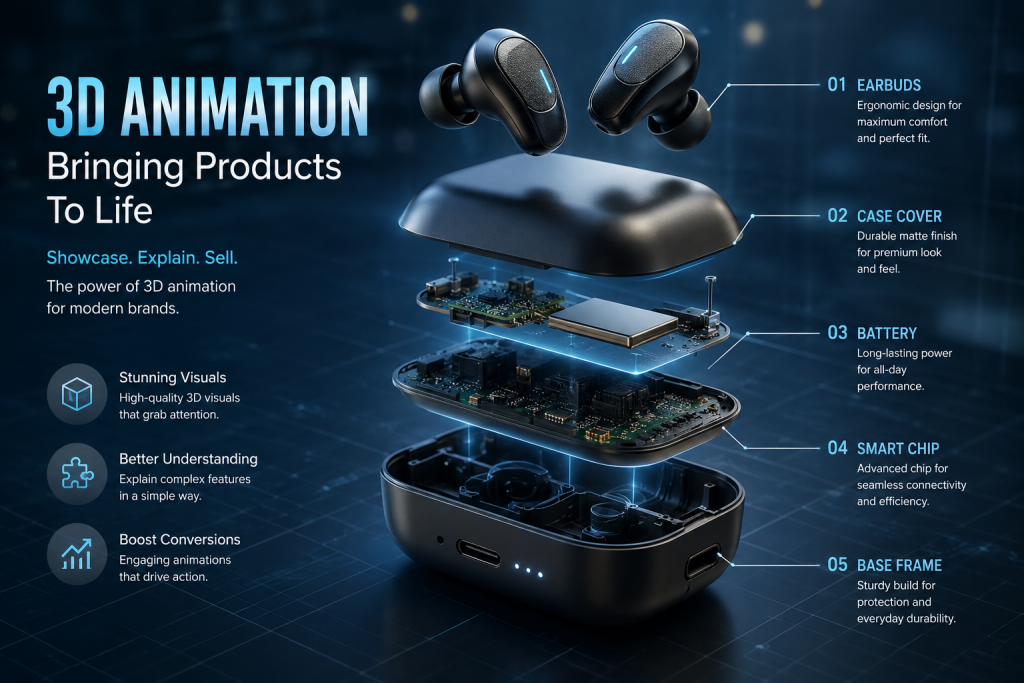
This is exactly what Professional 3D product rendering USA studios build for ecommerce catalogs: turntable spins, exploded views, and macro-detail passes that answer questions before shoppers think to ask them.
Making product features easier to understand
Some products are genuinely hard to explain. A spec sheet says “dual-piston pump with thermal regulation.” Cool. What does that mean for my mornings? An animation shows it, pressure building, temperature holding, the mechanism doing its job in five seconds of motion.
For genuinely complex products, businesses often pair product animation with an animated explainer video production company to walk buyers through the whole story — problem, mechanism, payoff, in under ninety seconds. Understanding is the shortest road to trust, and motion is the fastest vehicle on it.
Creating realistic product experiences
Modern 3D rendering is past the point where shoppers can tell it from photography, and honestly, past the point where it matters. Physically accurate materials, real light behavior, true-to-life scale. When a render is indistinguishable from the product, the buyer’s brain treats the information as verified, not advertised. That shift, from “they claim” to “I’ve seen”, is the entire psychology of buyer confidence.
3D Product Animation vs Traditional Product Images
Let’s settle the comparison properly, because this isn’t about taste. It’s about what each format can actually do for a skeptical stranger.
Static visuals vs animated experiences
A photo works as a proof. While animation is a demonstration of the product. That’s the whole difference, and it cascades through everything a buyer cares about:
| What the Buyer Wants | Static Product Images | 3D Product Animation |
| See the whole product | 4–6 chosen angles | Every angle, on demand |
| Understand how it works | Guess from captions | Watch it operate in seconds |
| Judge size & scale | Compare to a prop in the photo | True-scale scenes & AR placement |
| Verify build quality | Trust the close-up crop | Macro passes over seams, joints, materials |
| Feel confident to buy | Hope for the best | Verify, then decide |
Which format builds more trust?
Ask the returned data. The NRF’s $890 billion returns figure is overwhelmingly a story about photos overpromising, items that looked one way in the gallery and arrived another way at the door. Industry data on 3D and AR product visualization shows return-rate reductions of up to 40% in categories where size, fit, and assembly drive returns. Trust isn’t just a feeling. It has a return-rate column in your spreadsheet.
The impact on customer engagement
Shopify reports that merchants adding 3D content see a 94% conversion lift on average among shoppers who interact with it. Not a typo. When people can explore a product instead of just looking at it, they stay longer, understand more, and buy with both eyes open. Engagement isn’t a vanity metric here, it’s confidence accumulating in real time.
Benefits of 3D Product Animation for USA Businesses
Zoom out from the psychology and the business case gets very practical, very fast.
Higher customer engagement
Motion wins attention in every environment that matters: the feed, the product page, the inbox. One master animation cuts down into ad loops, email GIFs, PDP heroes, and marketplace videos, engagement compounding from a single production investment.
Better product understanding
When buyers understand the product, support tickets drop, pre-sale questions shrink, and sales conversations skip straight to the close. Understanding scales in a way your support team never will.
Stronger purchase confidence
Confidence converts. It also compounds: confident first-time buyers become repeat buyers, and repeat buyers become the reviews that convince the next wave. Brand polish feeds this loop too, details as small as animated logos on product videos signal a company that sweats details, which is why teams often add Professional Logo Animation Services to the same production brief.
How Leading USA Brands Use 3D Product Animation
The playbook across the USA is remarkably consistent. Three channels, one asset library.
Ecommerce product pages
Above the fold, where attention is won or lost: a looping 3D hero or interactive spin where the static gallery used to sit. Shopify natively supports 3D models and video, so the technical barrier is basically zero. The brands doing this watched their time-on-page and add-to-cart rates move in weeks, not quarters.
Product launch campaigns
Here’s the move that still feels like cheating: launch before the product exists. Because animations are built from CAD files and design specs, the launch film, the pre-order page, and the teaser campaign can all go live while manufacturing is still ramping. Hype on schedule, not on the factory’s schedule.
Social media and paid advertising
Two seconds. That’s your feed budget. A product assembling itself in mid-air or rotating under dramatic light earns those two seconds; a flatlay doesn’t. Any experienced 3d animation company in USA will tell you the same thing: paid social runs on motion now, and the brands winning auctions are the ones whose creativity stops thumbs.
Choosing the Right 3D Product Animation Company
The studio you pick determines whether you get a trust-building asset or an expensive screensaver. Three things to check before signing anything.
Portfolio and industry expertise
Look for work in your category or one with similar physics and materials. A studio that’s animated skincare textures understands refraction and viscosity; one that’s only done with hard-surface gadgets will learn on your invoice. Any serious 3d animation video production company will happily walk you through relevant case studies, hesitation here is your red flag.
Quality, creativity, and accuracy
Accuracy is the underrated one. The animation must match the real product, dimensions, finishes, mechanisms, or you’ve built a beautiful liability that generates the exact returns you were trying to prevent. Creativity gets attention; accuracy keeps it. Demand both.
Scalability and project support
Your first animation won’t be your last. Once the model exists, every colorway, seasonal variant, and ad cutdown gets cheaper and faster, if the studio is built for ongoing production. Ask about revision policy, turnaround, and how they handle a 40-SKU catalog before you need them to handle a 40-SKU catalog.
Build Buyer Confidence with Professional 3D Product Animation
Every hesitant shopper is asking the same silent question: “Can I trust this?” The businesses growing fastest are the ones answering it visually.
Custom animations tailored to your products
Split Arts builds product animations around your buyer’s specific doubts, 360 spins, exploded views, feature demonstrations, launch films, and AR-ready assets. Nothing templated, nothing generic.
Help customers buy with confidence
The goal isn’t prettier content. It’s almost the end. Show buyers everything, answer questions before they’re asked, and watch hesitation turn into checkout completions.
Frequently Asked Questions
What is 3D product animation, exactly?
It’s a computer-generated video or interactive asset that shows your product in motion — rotating, assembling, operating, built from a digital 3D model. Think of it as a product demonstration that works on any screen, without a film crew or a physical prototype.
How does 3D animation build buyer trust?
By replacing claims with demonstrations. Buyers can inspect every angle, watch mechanisms operate, and judge scale and quality for themselves. Transparency signals confidence, and confidence is contagious, shoppers trust brands that clearly trust their own products.
Which industries benefit most from 3D product animation?
Any category where buyers need to understand size, mechanism, materials, or assembly: consumer electronics, furniture, beauty and skincare, fitness equipment, kitchen products, medical devices, and industrial components. If customers ever ask “but how does it actually work,” you qualify.
Is 3D product animation worth it for smaller businesses?
Usually, yes, because the math isn’t about the animation, it’s about the assets. One production yields a product page hero, ad creatives, email GIFs, and social cutdowns. Compared to repeated photo shoots across a growing catalog, animation typically wins on cost within a year.
How do I choose between animation studios?
Check category experience in the portfolio, ask how they guarantee dimensional accuracy, and confirm their revision and scalability terms. A studio that leads with strategy questions — who buys this, what do they doubt, will outperform one that leads with software talk.
Partner with us!
Buyer confidence is earned long before someone reaches the checkout page. Every unanswered question, every hidden detail, and every moment of uncertainty gives customers another reason to leave and keep looking.
At Split Arts, we help businesses remove those doubts by creating product experiences that are clear, informative, and easy to trust. Because when customers feel certain about what they’re buying, choosing your brand becomes the easiest decision they’ll make.