3D animation is a powerful and immersive visual storytelling tool used in films, games, advertisements, and simulations. Whether it’s creating lifelike characters for a blockbuster movie or bringing a brand’s product to life in an ad, 3D animation is a critical technique in modern media. But how does 3D animation work? How do we go from an idea to a final animated scene?
In this guide, we will walk you through the complete 3D animation process, covering everything from concept development to rendering the final video. Whether you’re new to animation or an experienced creator, this guide will provide you with the essential steps and insights.
What is 3D Animation?
3D animation refers to the process of creating moving images in a three-dimensional space, using computer software. Unlike 2D animation, which uses flat images, 3D animation adds depth and makes objects appear as if they exist in the real world. Digital 3D models are created, manipulated, and animated to produce lifelike motion, and these models are then rendered into 2D images or video.
In 3D animation, objects are given virtual dimensions height, width, and depth making them appear real and dynamic. The process involves several stages, including modeling, rigging, animation, and rendering.
1. Pre-Production: Planning and Conceptualization
The pre-production phase is where the foundation for your animation is laid. It is the planning and conceptualization phase where everything is designed, structured, and set in motion for the actual animation to begin. Proper pre-production is essential to creating a smooth workflow and ensuring that your animation has direction.
a) Concept and Script Writing
Every great animation starts with a script. The script outlines the narrative, dialogue, and the actions of the characters. Whether you’re making an animated short, a video game cutscene, or a feature-length movie, the script is the backbone of your animation project. It defines the emotional tone, character development, and story arc, all of which need to be communicated clearly to the audience.
At Split Arts, we help you develop compelling stories that engage your audience from start to finish. A well-crafted script is vital for keeping your animation on track and ensuring consistency throughout the production process.
b) Storyboarding
Once the script is written, the next step is storyboarding. Storyboards are visual sketches that outline the key scenes, camera angles, character movements, and overall sequence of events in the animation. Think of it as the visual version of the script.
Storyboarding helps visualize the flow of the animation, ensuring that the timing and pacing of the story align with the script’s intent. Each frame in the storyboard represents a shot, showing how the animation will move from one scene to the next.
Our storyboard artists work with you to bring your script to life, ensuring that your vision is captured visually, which in turn will guide animators throughout production.
c) Styleframes and Concept Art
Once the storyboard is complete, styleframes and concept art help define the visual style of the animation. Styleframes are fully rendered images that depict the look and feel of the characters, settings, and objects. These visuals allow you to experiment with color palettes, textures, and lighting, giving a clearer idea of how the final animation will appear. Concept art, on the other hand, focuses on the character design and environment layout.
This step is crucial for ensuring consistency in the art direction across the entire project.
2. Production: Bringing Your Animation to Life
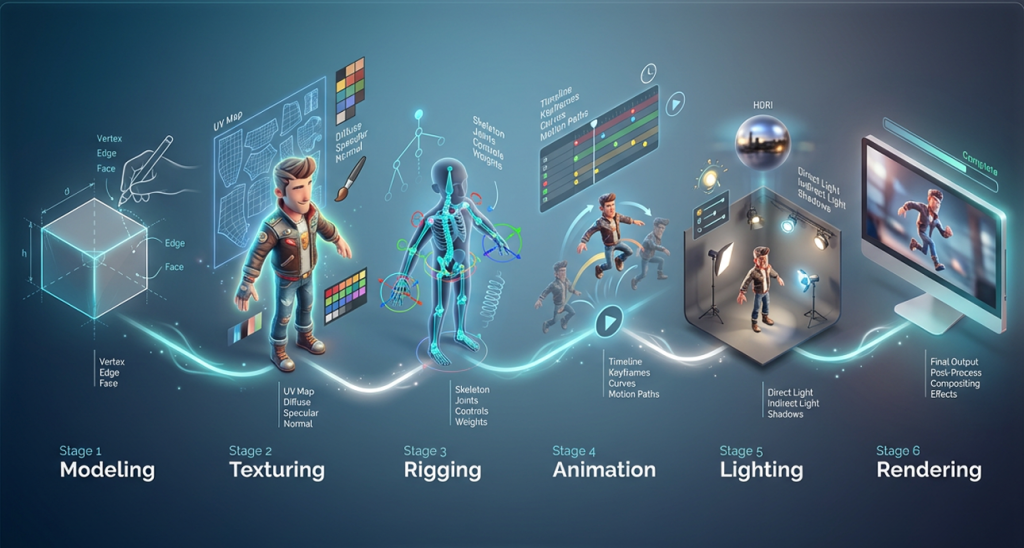
Once the pre-production is complete, the production phase begins, which is where the animation truly starts to take shape. The production process includes 3D modeling, rigging, texturing, animation, and lighting. These stages are the building blocks for your animation.
a) 3D Modeling
The first step in the production phase is 3D modeling. In this process, 3D artists create the digital models for characters, environments, and props. 3D models are made using polygonal meshes, which consist of vertices, edges, and faces that form the structure of the object.
Whether you’re creating a realistic human figure, a fantastical creature, or a detailed environment, it all starts here. The goal is to create models that are both aesthetically pleasing and functional for animation.
We specialize in creating detailed and accurate 3D models, whether it’s for realistic human characters, vehicles, or complex environments.
b) Texturing and UV Mapping
Once models are created, they need to be textured to give them realistic surfaces, such as skin, clothing, and environmental materials. Texturing involves applying digital images (textures) to 3D surfaces. These textures provide color, detail, and realism.
UV mapping is a critical part of this process. It involves unwrapping the 3D model into a 2D representation, allowing textures to be applied accurately. This ensures that details such as wrinkles, dirt, and fabric are realistically mapped to the character or environment.
c) Rigging and Skinning
Once the models are ready, rigging and skinning make it possible to animate them. Rigging is the process of creating a skeleton (or “rig”) for a model, allowing animators to control its movements. Skinning refers to attaching the model’s mesh to the rig, ensuring it deforms correctly when moved.
Our rigging team creates robust rigs that give your characters natural, realistic movement, whether it’s for a game or animated film.
d) Animation
With the rigged models in place, it’s time to bring them to life through animation. Animators use keyframes to define the beginning and end of each movement. The software then generates the in-between frames to create smooth motion. If required, motion capture can be used to record realistic movements from real actors.
We bring out the full potential of your characters, whether they need expressive facial animations, action sequences, or emotion-driven movements.
3. Post-Production: Refining the Final Animation
After the animation is complete, post-production begins. This phase involves rendering, compositing, and final editing. It’s where everything comes together, and the final touches are added.
a) Rendering
Rendering is the process of converting the 3D models and animations into 2D images or video frames. This stage is highly computationally intensive as it involves calculating lighting, shadows, textures, and the movement of objects. At Split Arts, we use high-performance render farms to ensure your animations are rendered quickly and at the highest quality.
b) Compositing and VFX
Compositing involves combining different layers (like background, effects, and foreground elements) to create the final image. Visual Effects (VFX), such as explosions, weather effects, and particle systems, are added in this phase. VFX can dramatically enhance the realism or stylization of your animation.
We specialize in VFX services, helping your animation achieve a level of realism or fantastical charm as needed.
c) Final Sound Design and Edits
Finally, sound design and final editing take place, where the audio (dialogue, sound effects, and music) is integrated with the animation. Color correction and final output also happen during this stage to ensure the animation looks as polished as possible before being delivered.
Conclusion: Bringing Your 3D Animation to Life
Creating 3D animation is a complex, multi-step process that combines art, creativity, and technology. Each stage, from pre-production to post-production, plays a vital role in bringing an animation project to life.
We offer top 3d animation services, from scriptwriting and storyboarding to rendering and post-production. Whether you’re looking to create cinematic animations, game assets, or advertisements, we work closely with you to ensure every aspect of the animation is perfectly executed.
Ready to start your 3D animation project? Get in touch with us today and let our team of experts help turn your ideas into an animated reality!